

Medical records management: what to look for in software
|
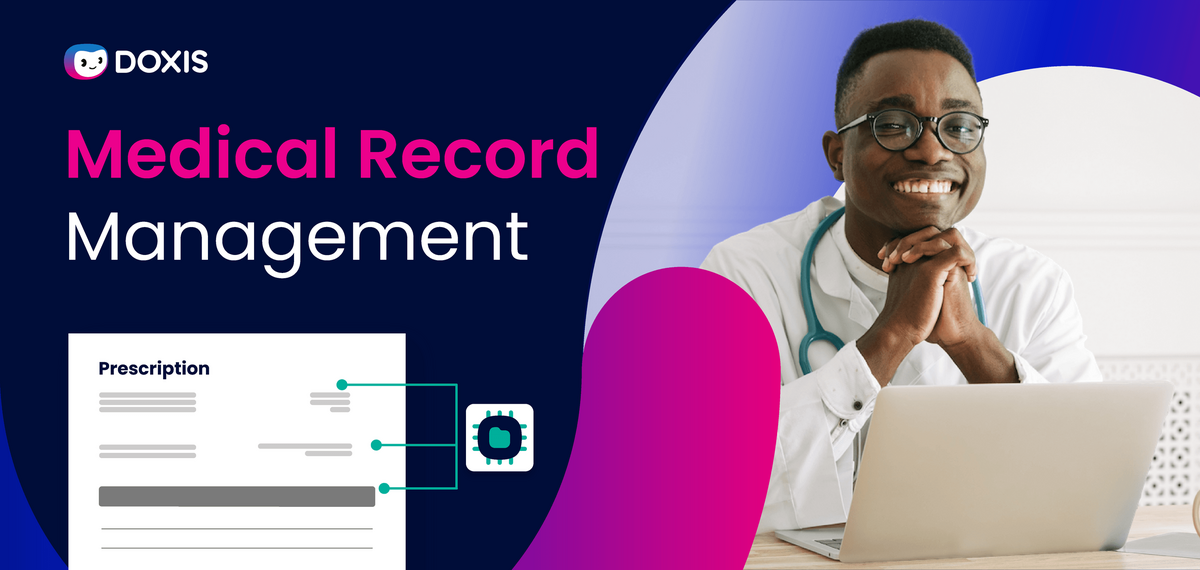
Patient files rarely live in one place. Referral letters sit in one system, lab results in another, and scanned intake forms wait in a shared drive until someone has time to file them. For healthcare IT and compliance teams, that fragmentation turns a routine records request into a scramble across departments.
According to the IBM Cost of a Data Breach Report 2025, healthcare has been the most expensive industry for data breaches for 14 consecutive years, with an average incident now costing $7.42 million and taking 279 days to identify and contain. Every scattered patient file, unmonitored folder, and undocumented access point adds to that exposure.
This guide breaks down what medical records management software actually needs to do, the features worth prioritizing during evaluation, and how Doxis for healthcare approaches patient file management, capture, and compliance.
Key Takeaways
- Medical records management software centralizes, secures, and governs patient files across their entire lifecycle, from intake to retention and disposition.
- Compliance and security controls, not just storage, are what separate records management software from a generic file repository.
- AI-powered document capture reduces the manual scanning and labeling work that slows down patient file processing.
- Retention schedules and audit trails need to be automated, not tracked manually in spreadsheets.
- Interoperability with EHR, SAP, and other clinical or administrative systems determines how much value the software delivers day to day.
- Doxis combines document capture, classification, retention automation, and compliance-ready governance in one platform for patient records.
What is medical records management software?
Medical records management software is a system that captures, organizes, stores, and governs patient documentation, such as referrals, consent forms, diagnostic reports, and correspondence, throughout its lifecycle. It applies structure and metadata to files so healthcare organizations can retrieve, secure, and retain patient records in line with regulatory requirements.
Why medical records management matters for healthcare organizations
A patient record is rarely a single document. It is a growing collection of referrals, test results, consent forms, insurance correspondence, and clinical notes that accumulate from multiple departments and multiple facilities. When that collection is split across shared drives, paper files, and disconnected systems, staff lose time tracking down documents instead of supporting patient care.
The compliance stakes compound the operational ones. HIPAA's Privacy and Security Rules require documented policies, access controls, and retrievable records, and regulators expect organizations to produce specific documentation on request, sometimes within tight legal deadlines. Software built for records management, rather than general file storage, is what makes that retrieval possible without a manual search through every department.
Key features to look for in a medical records management system
Not every document platform is built for the realities of patient data. These are the capabilities worth testing during any evaluation.
HIPAA-ready compliance and security controls
Patient data demands more than password-protected folders. Look for role-based permissions, encryption at rest and in transit, and a system that supports the administrative, technical, and physical safeguards required under HIPAA's Security Rule. The software should make it straightforward to demonstrate compliance during an audit, not just claim it in a data sheet.
Centralized, structured patient files
A strong system consolidates referrals, lab results, imaging reports, and correspondence into a single, structured electronic patient file instead of leaving them scattered across departmental repositories. Staff should be able to open one record and see the complete document history for that patient, correctly indexed by type, date, and origin.
Intelligent capture and classification of medical documents
Manually scanning and labeling incoming patient documents is slow and error-prone. Look for AI-powered document capture that reads incoming documents, classifies them by type such as prescription, diagnosis, or referral, tags them with the correct patient identifier, and files them automatically. This removes a repetitive manual step and gets documents into the right record faster.
Retention rules and audit trails
Healthcare records are subject to retention schedules that vary by document type, state, and regulation. The software should apply retention rules automatically, flag records approaching disposition, and maintain a complete audit trail showing who created, viewed, modified, or approved every document.
Interoperability with EHR, SAP, and other systems
Records management software rarely operates alone. It needs to connect with your EHR for clinical context, your SAP archiving or ERP environment for administrative and billing workflows, and other systems your teams already rely on. Open APIs and pre-built integrations reduce the custom development work needed to make that connection real.
Scalable, role-based access governance
As patient volumes grow, so does the number of people who need some, but not all, access to a given record. Granular, role-based permissions let you control exactly who can view, edit, or export specific documents, while the system scales to handle growing document volumes without a drop in performance.
Common Mistakes to Avoid
Even well-intentioned HR teams run into the same pitfalls when managing employee files:
- Storing files across multiple disconnected systems, such as shared drives, email, and a separate HR platform, with no single source of truth
- Applying access permissions inconsistently, leaving sensitive salary or medical data visible to staff who don't need it
- Tracking retention deadlines manually in spreadsheets instead of automating deletion and archiving
- Failing to remove rejected applicant data in line with GDPR's data minimization requirements
- Leaving personnel files disconnected from the HR or payroll system, forcing duplicate data entry
- Treating employee file management as a one-time cleanup project rather than an ongoing, governed process
HR management with ECM
See how you can maintain a complete overview of all employees and applicant information: Electronic HR files provide you secure access at any time and from anywhere with Doxis HR Management.
Download the BrochureCommon challenges in managing patient records
Even well-resourced healthcare organizations run into the same recurring problems:
- Fragmented storage: patient documents split across shared drives, email, and departmental systems with no single source of truth
- Manual filing backlogs: staff scanning and labeling documents by hand, creating delays between intake and availability in the patient file
- Inconsistent retention practices: retention and disposition tracked in spreadsheets instead of enforced automatically
- Limited audit visibility: no reliable way to show who accessed or modified a record when compliance teams need proof
- Disconnected systems: records management software that does not talk to the EHR, billing, or ERP systems staff use every day
One platform, more than just patient records
Medical records management is one use case built on the same underlying Doxis platform, the capture, classification, retention, and governance logic described above isn't specific to patient files. The same configurable structure adapts easily to other document-heavy processes across a healthcare organization, most commonly employee records.
Hospitals and clinics run large, often unionized workforces with their own document lifecycle: contracts, credentialing files, certifications, performance reviews, and leave records that need the same audit trail and retention discipline as patient documentation. Doxis supports this with pre-built integrations for SAP SuccessFactors and Workday, so digital personnel files stay connected to the HR systems teams already use rather than becoming a separate silo.
For organizations already running Doxis for medical records, extending into HR, contract management, or invoice processing is a matter of configuration, not a new platform purchase, a relevant consideration for IT teams evaluating total cost of ownership alongside the criteria above.
Ready to see how Doxis handles patient records at your organization's scale? Request a free demo to walk through your specific compliance and workflow requirements.
How to choose the right patient records management system with Doxis
- Compliance-ready architecture: Doxis supports HIPAA compliance requirements for handling protected health information, is EU GDPR-certified, and holds certification for records management in accordance with ISO 16175:2020, giving compliance teams a documented foundation rather than a patchwork of manual controls.
- AI-powered document capture: Doxis classifies incoming patient documents, such as prescriptions, diagnoses, and referrals, tags them with the correct patient identifier, and files them into the record automatically, replacing manual scanning and labeling.
- Unified patient file: Doxis consolidates patient documents into a single, structured file with full version history, so staff work from one accurate record instead of searching across departments.
- Automated retention and audit trails: Doxis applies retention rules by document type and maintains a complete audit trail of who created, viewed, or modified each record, supporting audit readiness without manual tracking.
- Deep SAP and system integration: Doxis integrates with SAP and other enterprise systems, connecting administrative and billing documents to the finance and HR workflows hospital back-office teams already use, alongside clinical-system interoperability (HL7, FHIR, DICOM, IHE) for the clinical side.
- Modular, scalable deployment: Organizations can start with document management for one department and expand into intelligent capture, workflow automation, or SAP-integrated records management as needs grow, without replatforming.
Doxis has been recognized as a Leader in the Gartner® Magic Quadrant™ for Document Management 2026, and a Forrester Consulting Total Economic Impact™ study of the Doxis platform found a 336% ROI over three years, with payback in under six months.
Automate Work. Accelerate Business.
Bring together AI, ECM, and workflow automation in one powerful enterprise platform.
FAQs on medical records management
What is the difference between medical records management software and an EHR?
An EHR focuses on clinical documentation created during patient care, such as diagnoses and treatment plans. Medical records management software governs the full document lifecycle, including intake, classification, retention, and compliance, working alongside the EHR rather than replacing it.
Is medical records management software required to be HIPAA compliant?
Any software that stores or processes protected health information must support the administrative, physical, and technical safeguards required under HIPAA's Security Rule, including access controls, encryption, and audit logging.
How long do healthcare organizations need to retain patient records?
Retention periods vary by state and document type, and some records must be kept for a set number of years after the last patient encounter. A records management system should apply the correct retention schedule automatically based on document type and jurisdiction.
Can medical records management software integrate with an existing EHR?
Yes. Platforms built for enterprise use, such as Doxis, are designed to integrate with EHR, SAP, and other clinical or administrative systems through open APIs, so patient documents stay connected to the systems staff already use.
What happens to paper medical records during a transition to digital records management?
Paper records are scanned and processed through intelligent capture, which classifies each document and files it into the correct patient record, so historical files become searchable alongside newly created digital documents.
How does AI improve patient records management?
AI-powered document capture reads incoming files, identifies the document type, extracts key data such as the patient identifier, and files the document automatically, reducing the manual work involved in processing high volumes of patient documentation.
Who should be involved in evaluating medical records management software?
Evaluation involves healthcare IT, compliance and privacy officers, and records or health information management staff, since the software needs to satisfy technical, regulatory, and day-to-day operational requirements at once.
Does medical records management software replace the need for a compliance program?
No. The software supports a compliance program by enforcing access controls, retention rules, and audit trails, but organizations still need documented policies, staff training, and oversight to meet HIPAA and other regulatory requirements in full.



How can we help you?
+49 (0) 30 498582-0Your message has reached us!
We appreciate your interest and will get back to you shortly.