

eDocuments: How to exchange eInvoices securely across borders
|
A supplier in Belgium sends an invoice your finance team can't process automatically, because it arrives in a format your system doesn't recognize.
Multiply that across every country you trade with, and cross-border invoicing turns into a patchwork of manual checks, rejected files, and late payments.
According to the 2026 Billentis report, only 29% of the roughly 600 billion B2B invoices exchanged globally each year are electronic, and cross-border invoices make up a fraction of that.
As mandates expand and networks like Peppol connect more countries, the gap between businesses that can exchange eDocuments automatically and those still keying data in by hand is only going to widen.
This guide explains what eDocuments are, how eDocument Exchange lets you send and receive eInvoices and other electronic documents securely across borders, and what to look for when you're choosing how to connect.
Key takeaways
- An eDocument is a document in a structured, machine-readable format such as XML, built to be processed by systems without manual re-entry.
- eInvoices are the most common eDocument type, but purchasing documents, dispatch notifications, and customs filings increasingly move electronically too.
- Peppol and country-specific portals such as Chorus Pro, SdI, and KSeF let businesses exchange eDocuments with partners across borders through certified access points.
- Doxis eDocument Exchange for Incoming Invoices connects to Peppol and country platforms in more than 30 countries, as an add-on to Doxis Intelligent P2P Automation.
- Outbound eInvoicing in SAP runs through a separate capability, Doxis Billing for SAP, which dispatches invoices in the format each market requires.
What is an eDocument?
An eDocument is a document in an electronic format, typically JSON or XML. Unlike a PDF, an eDocument isn't designed for a person to read and process manually. It's built to be read, validated, and archived by IT systems with no human intervention required.
What are examples of an eDocument?
The eDocument most people have heard of is the eInvoice.
A growing number of countries now require businesses to issue eInvoices for transactions with public authorities, and mandates are extending to company-to-company transactions too.
Beyond invoices, you can exchange any document type electronically.
Common examples include:
- Dispatch notifications: delivery notes with detailed shipment information
- Customs and tax documents: customs declarations or tax filings
- Purchasing documents: orders and order confirmations
- Declarations to authorities: forms submitted to tax or social security bodies
How does eDocument Exchange work?
Businesses connect to networks and platforms that handle the cross-company exchange of eInvoices and other eDocuments.
Peppol (Pan-European Public Procurement Online) is the best known: it encrypts documents in transit, routes them to the right recipient, and enforces a standard format on both ends.
To receive documents through a network like Peppol, your ERP system needs to connect via a certified access point.
That connection is what turns a manual, format-by-format exchange into one that runs automatically from invoice receipt through to posting.
Not every country routes through Peppol exclusively.
ome, like France and Poland, pair it with a national platform, Chorus Pro and KSeF respectively, that handles specific transaction types.
Others, like Germany, mandate eInvoicing but leave the choice of exchange platform to the business.
Knowing which network applies where you trade is the first step to connecting correctly.
What challenges do eInvoices pose in cross-border business?
Cross-border eDocument exchange gets complicated fast, mainly because mandates aren't harmonised.
A country with a mandatory eInvoicing regime often specifies its own platform: Italy's SdI, Spain's FACeB2B, and Poland's KSeF each apply their own rules on top of, or alongside, Peppol.
For years, the requirement to send invoices through networks like Peppol applied only to business-to-government transactions.
As mandates extend to company-to-company trade, Peppol has become a network for both B2G and B2B, opening up international trade that used to require a separate integration for every country.
To capture that opportunity, businesses first have to connect their own systems, whether that's an ERP, a P2P platform, or a dedicated exchange add-on, to Peppol and the relevant national platforms.
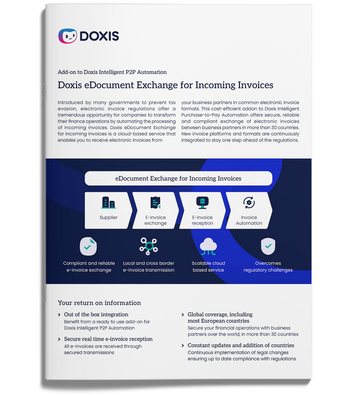
Doxis eDocument Exchange for Incoming Invoices
Secure, reliable and compliant exchange of electronic invoices between business partners in more than 30 countries
Read nowDoxis eDocument Exchange for Incoming Invoices
Doxis eDocument Exchange for Incoming Invoices is an add-on to Doxis Intelligent P2P Automation for Invoices that maintains permanent connections to Peppol and country-specific platforms, so incoming eInvoices arrive ready for processing rather than sitting in a format your system can't read.
It covers business partners in more than 30 countries, with named coverage including Austria, Germany, France, Italy, the Netherlands, Poland, Belgium, and Spain, connecting through Peppol alongside local portals such as FACeB2B in Spain, SdI in Italy, Chorus Pro in France, and KSeF in Poland.
New countries are added as they move to mandatory eInvoicing, so the connection stays current without extra setup on your side.
Accept inbound invoices with Doxis
Here's how the inbound flow works, end to end:
- Accept inbound eInvoices: eDocument Exchange connects to the digital inbox via Peppol and country portals, and accepts eInvoices in real time.
- Capture invoice details: Doxis supports common formats including XRechnung, Factur-X, and eFattura, and extracts structured data into the correct eFile.
- Verify the eInvoice: Doxis checks formal and factual accuracy, flags missing or incorrect data, and cross-references the invoice against related documents like delivery notes.
- Release the eInvoice: Validated invoices move into a release workflow, with multi-stage approval where internal policy requires it.
- Post the eInvoice: Released invoice data goes to your financial accounting system, with automatic posting available when a purchase order reference is present.
- Archive the eInvoice: eInvoices are archived for their full retention period, in line with audit requirements.
Issue outbound invoices in SAP
Outbound eInvoicing runs through a different, SAP-specific capability: Doxis Billing for SAP.
It dispatches outbound eInvoices directly from SAP ERP or SAP S/4HANA, converting them into the format each market requires, whether that's XRechnung, ZUGFeRD, or Peppol BIS, and routing them to the right access point.
Because Doxis Billing for SAP and Doxis eDocument Exchange for Incoming Invoices both connect to the same audit-proof archive, inbound and outbound eInvoices land in the same customer or supplier file, giving finance one place to see the full transaction history rather than two separate systems to check.
How future-proof is eDocument Exchange?
Right now, the eInvoice is the eDocument type facing the most binding regulation. That's likely only the start.
ViDA and other mandates continue to expand which document types and company sizes are covered, and entire purchase-to-pay processes, delivery notes, order confirmations, standard contracts, could move to structured electronic exchange next.
If that happens, expect the same pattern: a new standardised format, transmitted through Peppol or an equivalent national platform.
Connecting through eDocument Exchange now means you're set up for that shift before it becomes mandatory.
Beyond eDocument Exchange: managing the full document lifecycle
Receiving a compliant eInvoice is only the start of its life in your systems.
Once it's captured, it needs to be matched against the right purchase order and delivery note, filed in the correct supplier record, retained for as long as local tax law requires, often seven to ten years, and retrievable the moment an auditor asks for it.
Running eDocument capture as a standalone add-on, separate from your document management and archiving, creates exactly the fragmentation cross-border trade is supposed to eliminate: one system for receiving invoices, another for storing them, and no shared view of a transaction from arrival to audit.
On the Doxis platform, eDocument Exchange feeds directly into:
- Structured filing: every eInvoice lands in the right eFile automatically, matched to its transaction
- Compliant archiving: documents are retained for their full legal period and stay audit-ready
- SAP integration: posted invoices and their source eDocuments stay linked inside SAP, not in a parallel system
- Workflow and approvals: verification and release run as part of the same process, not a manual handoff
Doxis: cross-border eInvoicing built into your content platform
Doxis handles cross-border eDocument exchange from both directions of your invoicing process.
Inbound, eDocument Exchange connects your P2P automation to Peppol and country platforms in more than 30 countries.
Outbound, Doxis Billing for SAP dispatches compliant eInvoices from SAP in the format each market requires.
Both run as part of Doxis Intelligent Content Automation, the same platform that handles document capture, archiving, and records management across your business.
That means an eInvoice doesn't just get accepted correctly, it lands in the right file, stays retrievable for its full retention period, and connects to the contract or purchase order it belongs to.
With Doxis, you get:
- Permanent, automatically updated connections to Peppol and country-specific platforms
- Real-time eInvoice reception with automatic receipt confirmation to the sender
- Formal and factual verification before an invoice reaches your approval workflow
- Outbound eInvoice dispatch from SAP, in the format each customer's country requires
- One audit-proof archive across inbound and outbound eInvoices, integrated with SAP and your DMS
- A platform that extends to contract management, records retention, and AI-driven document capture, not a single-purpose add-on
Doxis has been recognized as a Leader in the Gartner® Magic Quadrant™ for Document Management 2026.
Want to see eDocument Exchange in action? Request a live demo.
Automate Work. Accelerate Business.
Bring together AI, ECM, and workflow automation in one powerful enterprise platform.
FAQs on eDocuments
Is an eInvoice an eDocument?
Yes. An eInvoice is machine-readable by definition, which makes it a specific type of eDocument.
What is eDocument Exchange?
eDocument Exchange is the process of sending and receiving electronic documents, most often eInvoices, through networks like Peppol and country-specific portals, in compliant, structured formats.
How many countries does Doxis eDocument Exchange cover?
Doxis eDocument Exchange for Incoming Invoices covers business partners in more than 30 countries, including Austria, Germany, France, Italy, the Netherlands, Poland, Belgium, and Spain, with new countries added as they adopt mandatory eInvoicing.
Does eDocument Exchange only work with SAP?
No. Doxis eDocument Exchange for Incoming Invoices is an add-on to Doxis Intelligent P2P Automation and works independently of your ERP. Outbound eInvoice dispatch through Doxis Billing for SAP is SAP-specific.
Is a PDF invoice an eInvoice?
No. A PDF is a digital copy of a paper document, not a structured, machine-readable file, so it doesn't meet the definition of an eInvoice under most mandates.
Why is eDocument Exchange important?
It replaces manual, country-by-country invoice handling with a single, standardised connection, so businesses can meet mandatory eInvoicing requirements and process cross-border transactions faster.
What happens if a country I trade with isn't on Peppol?
Many countries pair Peppol with a national platform, such as SdI in Italy or KSeF in Poland. Doxis eDocument Exchange connects to both, so coverage isn't limited to Peppol-only routes.



How can we help you?
+49 (0) 30 498582-0Your message has reached us!
We appreciate your interest and will get back to you shortly.