

Enterprise data extraction: How AI turns documents into workflow-ready data
|
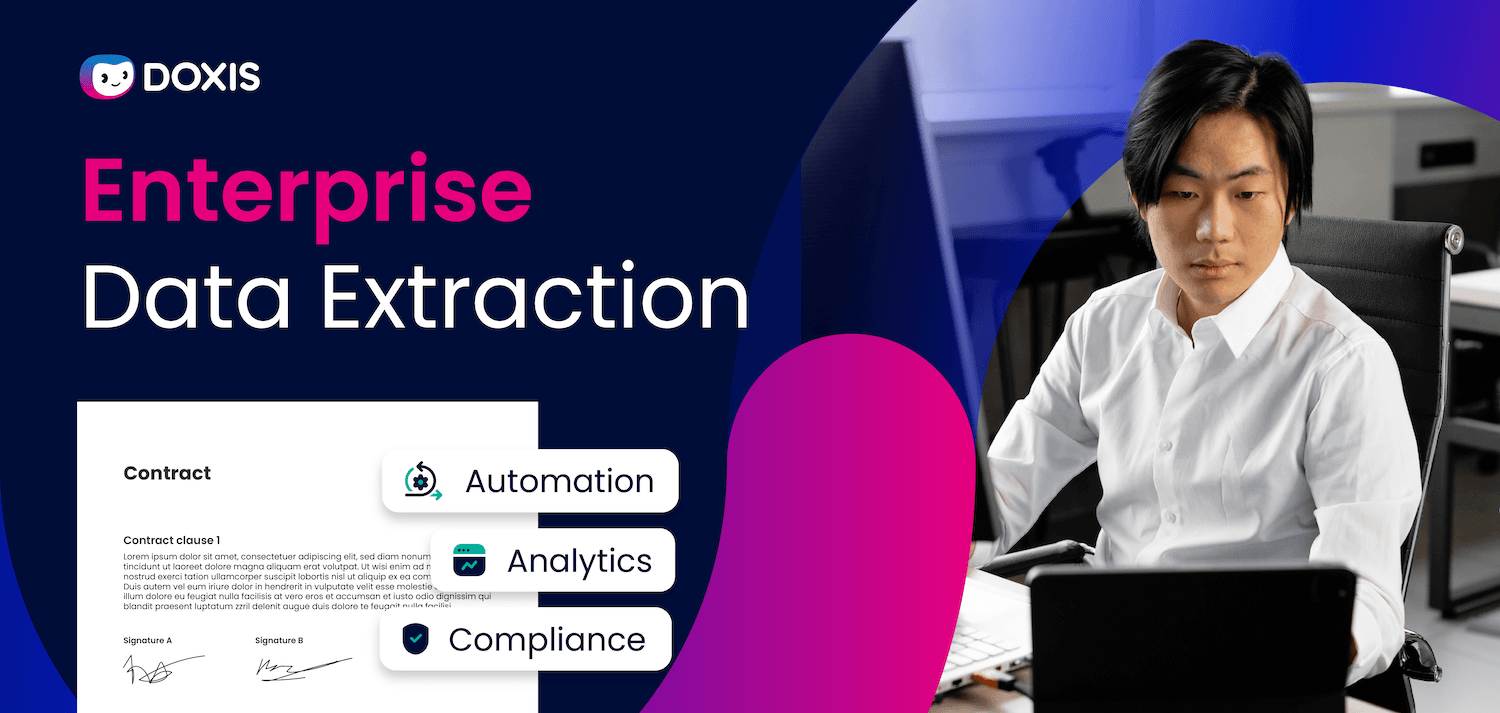
Your business runs on data. But a significant share of that data is buried in documents: invoices, contracts, purchase orders, employee forms, regulatory filings sitting in inboxes and shared drives, untouched by the systems where decisions actually happen.
According to Gartner, 80% of enterprise data is unstructured. That means the majority of your business-critical information exists outside the structured databases and ERP systems your workflows depend on.
It stays locked in PDFs and scanned documents while your teams either ignore it or process it manually, at a cost of time, accuracy, and opportunity.
Enterprise data extraction solves this.
This guide walks you through how it works, which technologies make it possible, where it delivers the most value, and what to look for when choosing a solution.
Key Takeaways
- Enterprise data extraction uses AI to pull structured, usable data from unstructured documents like invoices, contracts, and forms
- The process combines OCR, NLP, and machine learning to capture, classify, validate, and route data automatically
- 80% of enterprise data is unstructured, making automated extraction a strategic priority rather than a nice-to-have
- Key use cases include invoice processing, contract management, HR document handling, and compliance workflows
- Choosing the right platform means looking beyond extraction accuracy to workflow integration, validation, and scalability
What Is Enterprise Data Extraction?
Enterprise data extraction is the automated process of identifying and pulling structured data fields from unstructured or semi-structured business documents.
Intelligent document processing software uses AI technologies such as optical character recognition (OCR), natural language processing (NLP), and machine learning to read documents of any format or layout.
It then converts their content into structured, workflow-ready data that feeds directly into enterprise systems like ERPs, CRMs, and content management platforms.
In simple words: it takes a PDF, a scanned form, or an email attachment and turns the information inside it into data your business systems can actually use.
Why Enterprise Data Extraction Matters for Your Business
Manual data entry is slow, error-prone, and expensive. When your finance team re-types invoice data into your ERP, or your legal team manually reviews contracts for renewal dates, they are spending time on tasks that software handles far more accurately and at scale.
Organizations that extract and act on document data faster make better decisions: they catch contract renewal windows before they lapse, reconcile supplier invoices without delays, and flag compliance exceptions before they escalate.
The difference between those organizations and the ones still relying on manual re-entry is execution.
Enterprise data extraction is what closes that gap, giving your teams the information they need, in the systems they already use, without the bottleneck of manual processing.
Intelligent Content Automation for Enterprise Workflows
Discover how Doxis Intelligent Content Automation connects documents, data, and workflows across your business ecosystem.
Download the BrochureHow Does Enterprise Data Extraction Work?
Hey Doxi, how does enterprise data extraction work?
What looks like a single action, reading a document and pulling out data, is actually a coordinated sequence of steps. Each stage builds on the previous one, transforming a raw document into clean, validated, structured data.
Step 1 - Document Capture and Ingestion
Documents enter the pipeline from multiple channels: email attachments, scanned paper, uploaded PDFs, web forms, and EDI feeds.
A robust document management system ingests documents from all these sources automatically, eliminating the need for manual sorting or upload. At this stage, the system identifies the document and prepares it for processing.
Step 2 - Classification and OCR
Once ingested, the system classifies the document by type: is it an invoice, a purchase order, a contract, or an HR form? Classification happens through machine learning models trained on large document sets.
For scanned or image-based documents, optical character recognition (OCR) converts visual content into machine-readable text. Modern OCR engines handle poor scan quality, skewed pages, and multi-language documents with high accuracy.
Step 3 - AI-Powered Field Extraction (NLP + ML)
With the document classified and its text rendered, NLP and ML models extract the relevant data fields. For an invoice, that means vendor name, invoice number, line items, amounts, tax, and due date.
For a contract, it means parties, effective dates, payment terms, and renewal clauses. Unlike rule-based systems that break when a document layout changes, AI-powered extraction adapts to format variations automatically.
Step 4 - Validation and Confidence Scoring
Extracted data is validated against business rules and reference data. An invoice amount gets cross-checked against the corresponding purchase order.
A vendor name gets matched against the approved supplier list. Each extracted field receives a confidence score. High-confidence fields pass through automatically. Low-confidence fields, or those that fail validation rules, are flagged for human review through an exception workflow.
This human-in-the-loop design keeps accuracy high without requiring manual processing of every document.
Step 5 - Activation in Your ECM and Connected Systems
In an ECM platform like Doxis, extracted data automatically triggers the right follow-up process: an invoice routes into an approval workflow, a contract populates a contract management file with deadlines and obligations, an HR document updates a personnel record.
From there, Doxis connects that structured data outward to your ERP, CRM, or other business systems via certified integrations. The ECM is where documents, data, and workflows converge. Not a handoff point, but the operational hub where extraction becomes action.
Key Use Cases: Where Enterprises Extract the Most Value
Enterprise data extraction applies across every document-intensive function. The highest-ROI use cases share a common trait: high document volume, repetitive field extraction, and direct connection to a downstream workflow.
Invoice and Purchase Order Processing
Accounts payable teams handle thousands of invoices per month. Each one requires the same data fields, yet arrives in a different format from a different supplier.
Automated invoice processing reads every invoice, pulls the relevant fields, matches them against purchase orders, and routes exceptions for approval. The result is faster payment cycles, fewer errors, and a complete audit trail.
Contract Data Extraction
Large enterprises manage tens of thousands of active contracts. Key terms including renewal dates, pricing escalation clauses, liability caps, and SLA commitments are buried in document text and rarely visible to the teams that need them.
Extraction software reads contracts, structures their key data, and makes it searchable and reportable.
Finance knows which contracts are up for renewal. Procurement knows which suppliers are approaching volume thresholds. Legal knows which obligations are coming due.
HR and Employee Document Processing
Onboarding generates a surge of documents: employment agreements, identity verification, tax forms, benefits enrollment. Each requires data extraction and routing to multiple systems.
Automated extraction captures employee data from these documents at ingestion, routes them for approval, and populates HR and payroll systems without manual re-entry.
Doxis gives HR teams back 14 hours per week by automating document processes and workflows end to end, from applicant files through to SAP SuccessFactors integration.
Compliance and Regulatory Documents
In regulated industries, incoming regulatory correspondence, audit requests, and compliance filings require rapid response and complete tracking.
Automated extraction reads these documents, classifies them by regulation or obligation type, and triggers the appropriate workflow. Every interaction is logged with a full audit trail, a requirement in industries governed by GDPR, SOX, or sector-specific frameworks.
Key Technologies Behind Enterprise Data Extraction
Modern extraction platforms combine several AI technologies into a single, coordinated pipeline:
- OCR (Optical Character Recognition): converts scanned images and PDFs into machine-readable text, handling variable scan quality, fonts, and layouts
- NLP (Natural Language Processing): understands the meaning and context of text, enabling extraction of fields that are described differently across documents rather than appearing in fixed positions
- Machine Learning: trains models on labeled document sets so they learn to identify and extract fields accurately, and improve over time as they process more documents
- Computer Vision: reads the visual structure of a document, including tables, checkboxes, signatures, and stamps, to inform extraction logic beyond plain text
- Large Language Models (LLMs): interpret ambiguous or complex text, such as contract clauses or multi-page regulatory filings, where context and language understanding matter as much as field identification
These technologies work together. OCR renders the text. NLP and ML extract the fields. Computer vision handles layout complexity. LLMs address semantic ambiguity.
The combination is what separates modern AI-powered document capture from older rule-based systems that fail as soon as a document layout changes.
Common Challenges and How to Overcome Them
Enterprise data extraction is not without its obstacles. Understanding them upfront helps you evaluate solutions and set realistic expectations.
Document variability
Pilot programs run on clean, representative documents. Production environments surface the full range of real-world messiness: poor scan quality, non-standard layouts, handwritten annotations, and mixed-language documents.
The solution is choosing a platform built on adaptive ML models rather than rigid extraction templates.
Integration debt
Extracted data only creates value when it flows into the right system at the right moment. Platforms that require extensive custom development to connect with your ERP, CRM, or ECM add cost and delay that undermine ROI.
Prioritize platforms with pre-built connectors and open APIs.
Low adoption
If business users cannot see where an extracted value came from, they will not rely on it. Explainability features, including source tracing, confidence scores, and full audit trails, are not optional for enterprise deployments.
They are what converts technically capable software into a system your teams use.
Exception handling
Every extraction pipeline surfaces documents it cannot process with high confidence. How those exceptions are routed, reviewed, and resolved determines whether your automation runs smoothly or creates a backlog of unresolved edge cases.
How Doxis Turns Extracted Data into Workflow-Ready Intelligence
Your documents contain more business-critical information than your current systems can see. The challenge is the gap between where the data lives and where it needs to go.
Doxis combines ECM, IDP, and BPM in a single system, so extracted data does not stop at capture. It flows directly into the workflows, approvals, and integrations that drive your operations.
With Doxis, your organization benefits from:
- AI-powered IDP with Doxis AI.dp: classifies, extracts, and validates data from invoices, contracts, HR documents, and more with high accuracy out of the box
- Built-in validation and exception workflows: confidence scoring and business rule checks flag exceptions automatically, keeping human review focused on what matters
- Full audit trails: every extracted field is traceable to its source document, with metadata logging to support GDPR, SOX, HIPAA, and ISO compliance requirements
- GDPR-compliant, ISO 27001 certified: Doxis meets enterprise-grade data protection and security standards, with audit-proof archiving and role-based access control built into the platform
- Broad ERP and CRM integration: extracted data connects directly to SAP, Microsoft Dynamics, Salesforce, and other leading business systems via certified integrations and open APIs, with no custom middleware required Unified ECM and BPM: documents and their data are managed, versioned, and routed within a single platform, eliminating handoffs between disconnected systems
- Modular and scalable: start with invoice automation or contract extraction, and expand to additional document types and processes as your needs grow
Request a free demo below and see how Doxis turns your document backlog into workflow-ready intelligence.
Automate Work. Accelerate Business.
Bring together AI, ECM, and workflow automation in one powerful enterprise platform.
FAQs on Enterprise Data Extraction
What is enterprise data extraction?
Enterprise data extraction is the automated process of pulling structured data fields from business documents such as invoices, contracts, forms, and reports. It uses AI technologies including OCR, NLP, and machine learning to convert unstructured document content into structured data that integrates directly with enterprise systems like ERPs and CRMs.
How is enterprise data extraction different from OCR?
OCR is one component of data extraction: it converts scanned images into machine-readable text. Enterprise data extraction is the full pipeline, covering OCR plus AI-powered field identification, classification, validation, and workflow integration. OCR alone gives you text. Data extraction gives you structured, usable data in the right system at the right time.
What types of documents can AI extract data from?
Modern AI-powered extraction handles structured documents (standard forms with fixed fields), semi-structured documents (invoices and purchase orders with consistent but variable layouts), and unstructured documents (contracts, correspondence, and reports where content is in free-form text). Each type requires different extraction logic, which is why adaptive ML models outperform rule-based systems.
How accurate is AI-powered data extraction?
Accuracy depends on document type, scan quality, and the platform's training data. Leading IDP platforms achieve over 90% straight-through processing rates for standard document types in production environments. Confidence scoring and human-in-the-loop exception handling keep overall data quality high even for edge cases.
What is the difference between IDP and enterprise data extraction?
Intelligent Document Processing (IDP) is the broader category of technology that handles document ingestion, classification, extraction, validation, and workflow routing. Enterprise data extraction is the specific function within IDP focused on pulling structured data fields from documents. In practice, the terms are often used interchangeably when referring to the full document automation pipeline.
Is enterprise data extraction suitable for regulated industries?
Extraction platforms designed for enterprise use include the compliance features regulated industries require: full audit trails, role-based access control, data residency options, and traceability of every extracted field back to its source document. Doxis is GDPR-compliant and ISO 27001 certified, with audit-proof archiving built in, covering requirements across financial services, healthcare, manufacturing, and the public sector.
How does enterprise data extraction integrate with SAP or other ERPs?
Purpose-built platforms like Doxis provide certified integrations with SAP, Microsoft Dynamics, Salesforce, and other leading business systems. Extracted and validated data posts directly into the relevant ERP or CRM module, covering invoice posting, purchase order matching, and HR record updates, without custom middleware. Open APIs extend connectivity to legacy and specialized systems as needed.
How long does it take to implement an enterprise data extraction solution?
Implementation timelines vary by platform and document complexity. Cloud-based IDP platforms with pre-trained document models deliver production-ready extraction for standard invoice or contract types within weeks. More complex multi-document, multi-department rollouts with deep ERP integration require a phased approach across several months. Starting with a high-volume, clearly defined use case, such as invoice automation, consistently delivers the fastest time-to-value.



How can we help you?
+49 (0) 30 498582-0Your message has reached us!
We appreciate your interest and will get back to you shortly.