

Document fraud detection: How to detect fraud in enterprise workflows
|

Your finance, procurement, and HR teams process thousands of documents a month. Every invoice, contract, or ID they accept on faith is a potential entry point for fraud.
A single forged invoice or manipulated purchase order can slip past a reviewer working under deadline pressure. By the time it surfaces, the payment has already gone out.
According to the Association for Financial Professionals (2026), 76% of organizations reported experiencing attempted or actual payments fraud in 2025. Document fraud sits behind a large share of that exposure, because most payment and onboarding decisions still start with a document someone has to trust.
This guide walks you through how document fraud detection works, the concrete steps to build it into your enterprise workflows, and where automation outperforms manual review.
Key takeaways
- Document fraud detection combines metadata analysis, image forensics, and data cross-checking to flag forged or manipulated documents before they enter a business process.
- Manual review alone cannot keep pace with AI-generated forgeries, which now account for a growing share of fraud attempts across finance, HR, and procurement.
- A layered detection approach, covering duplicates, metadata, image tampering, and data matching, catches far more fraud than any single check on its own.
- Doxis applies duplicate detection, EXIF metadata inspection, copy-move analysis, and two-way/three-way matching directly inside your document workflows.
- Routing flagged documents to a human reviewer, rather than auto-rejecting them, protects both your fraud controls and your customer or vendor relationships.
What is document fraud detection?
Document fraud detection is the process of identifying forged, altered, or fabricated documents, such as invoices, contracts, or IDs, before they are accepted into a business process. It combines automated checks (metadata analysis, image forensics, data validation) with human review to flag documents that show signs of tampering or fabrication.
Why document fraud detection matters for your business
Document fraud detection is not just a compliance checkbox. It protects the financial and operational decisions your business makes every day.
A compromised decision has a real cost
Every document your business accepts carries a decision behind it: pay this invoice, onboard this vendor, approve this expense.
When a document is fraudulent, the decision built on top of it is compromised too. That cost lands somewhere concrete: your books, your compliance record, or a customer relationship you worked to build.
AI has made fraud harder to catch on sight
Generative AI tools can now produce convincing fake invoices, pay stubs, and IDs in minutes. The visual tells that used to give forgeries away are largely gone.
A reviewer scanning a document for a few seconds is not positioned to catch a synthetic forgery built specifically to pass that exact check.
Fraud risk compounds across high document volumes
A single missed invoice is a loss. A systemic gap in your fraud detection process, repeated across thousands of monthly transactions, is a much larger and harder-to-reverse problem.
Building detection into your document workflows, rather than relying on individual reviewers, closes that gap at scale.
The risk extends beyond invoices and IDs
This risk reaches into your contract management records too. A single altered clause or forged signature page can carry as much financial and legal weight as a fabricated payment request.
How to detect document fraud in enterprise workflows: Step by step
Hey Doxi, how does Doxis detect document fraud in enterprise workflows?
Effective document fraud detection is layered. No single check catches every type of fraud, so each step below adds a different signal to the decision.
Step 1: Capture and digitize every incoming document
Fraud detection starts with getting every document, whether it arrives by email, paper, EDI, or a supplier portal, into a single digital workflow. Documents that bypass your capture process also bypass your fraud checks.
An intelligent document processing (IDP) platform captures documents from multiple sources and normalizes them into a structured format your fraud checks can act on. This holds regardless of whether the original was a scanned PDF, a photo, or a native digital file.
Reliable document classification software tags each document by type the moment it arrives. Fraud checks then run against category-specific rules instead of one generic pass.
Step 2: Run duplicate and hash-based checks
Duplicate submission is one of the most common fraud patterns, particularly in expense reimbursement, invoice processing, and loyalty or rebate programs. Each incoming document gets a distinct digital fingerprint based on its content and structure.
This lets the system flag a second submission of the same invoice, receipt, or claim before it triggers a duplicate payment. It is fast to automate and catches a meaningful share of fraud attempts with minimal false positives, making it a logical first filter before deeper analysis.
Step 3: Analyze metadata and file origin
Every digital file carries metadata: creation date, editing software, device information, and revision history. Inconsistencies here are strong fraud indicators that are invisible to the naked eye.
A "scanned" document that was actually created in image-editing software, or a creation date that postdates the transaction it supposedly documents, are two common examples. EXIF metadata inspection reviews these hidden file properties automatically, flagging documents whose technical history contradicts what they claim to be.
Step 4: Detect image manipulation with copy-move and pixel-level analysis
Visual forgeries involve pasting one element into another image: a different signature, an altered amount, a swapped logo. Copy-move analysis identifies these pasted regions by detecting areas of an image that share identical or near-identical pixel patterns, a signature legitimate documents do not produce.
Grayscale and pixel-level analysis go a step further, examining compression artifacts and color inconsistencies. These reveal edits made after a document's original capture, even when the edit is not visible to a human reviewer.
Step 5: Flag AI-generated and synthetic document fraud
Generative AI has changed what a convincing forgery looks like. Instead of a crudely edited invoice, fraudsters can now generate an entire document from scratch, complete with realistic formatting, logos, and text.
None of the copy-paste artifacts older detection methods were built to catch are present. Detecting these forgeries requires checks that go beyond visual inspection: cross-referencing document structure against known-legitimate templates, and flagging documents with no editing history at all, a signature of AI generation rather than manual editing.
AI-based classification models trained to recognize the statistical fingerprints synthetic content leaves behind add another layer. As generative tools improve, this layer needs continuous retraining to keep pace with new fraud patterns.
Step 6: Cross-check data with two-way and three-way matching
A document can look visually authentic and still be fraudulent if the data inside it does not reconcile with the rest of the transaction. This is where invoice processing software earns its keep.
Two-way matching compares an invoice against its purchase order. Three-way matching adds the goods receipt, confirming that what was ordered, delivered, and billed actually align.
This step catches fraud that image-level analysis misses entirely, such as an invoice with inflated quantities or pricing that was never manipulated visually. The fraud lives in the data rather than the document's appearance.
Step 7: Route flagged documents for human review
Automated detection should narrow the funnel, not replace judgment on borderline cases. When a document trips one or more fraud indicators, route it to a trained reviewer with the specific flag attached, such as a duplicate match, metadata anomaly, or data mismatch, rather than a generic "suspicious" label.
This human-in-the-loop step also feeds your detection models. Reviewer decisions on flagged documents become training data that sharpens future accuracy, so the system gets better at distinguishing real fraud from false positives over time.
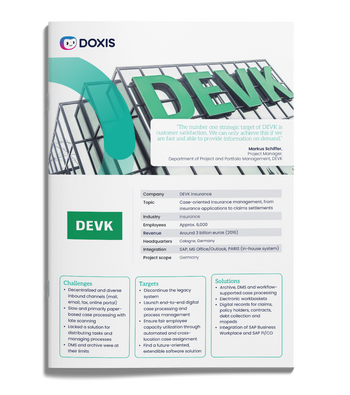
DEVK: Process-centric insurance management
Read all about how DEVK swiftly and securely manages their insurance processes.
Read nowManual review vs. automated fraud detection
The two approaches differ in what they can realistically catch and how they scale.
Manual review:
- Depends on what a person notices within the few seconds they spend on each document
- Breaks down as document volume and forgery sophistication both increase
- Misses metadata inconsistencies, pixel-level tampering, and AI-generated content without the layered checks built into modern enterprise OCR software
Automated fraud detection:
- Runs every document through the same consistent set of checks, at a speed and scale no manual process can match
- Does not replace your reviewers, it changes what they spend their time on, shifting from scanning every document to reviewing the smaller set the system has flagged
- Combined with human review on flagged cases, outperforms manual review on both accuracy and speed, which is why enterprise fraud detection increasingly runs on IDP platforms rather than individual judgment calls
Common mistakes to avoid in document fraud detection
Building fraud detection into your workflows is straightforward to get wrong in a few predictable ways.
Relying on a single check
Metadata analysis alone misses visual tampering, and image analysis alone misses data-level fraud. Treat each detection method as one layer among several, not a complete system on its own.
Auto-rejecting flagged documents without review
False positives happen. Rejecting a legitimate vendor invoice outright damages the relationship more than a short review delay would.
Leaving paper and fax channels outside the digital workflow
Fraud detection only works on documents that enter your system. Any channel that bypasses capture is a blind spot, regardless of how strong your other checks are.
Treating fraud detection as a one-time setup
Fraud tactics evolve, particularly with generative AI. Detection models need ongoing retraining against new patterns to stay effective.
Ignoring the audit trail
Every flagged document, decision, and reviewer action should be logged. This supports compliance and improves detection accuracy over time.
Detect document fraud before it reaches your books with Doxis
Catching document fraud after payment has gone out is far more expensive than catching it before. The Doxis Intelligent Content Automation platform builds fraud detection directly into your document workflows, so forged and manipulated documents get flagged before they trigger a payment, an onboarding decision, or a compliance issue.
Doxis customers have cut document fraud by up to 67% using this layered detection approach. The platform applies the approach this guide walks through, without requiring you to stitch together separate systems:
- Duplicate detection: assigns every document a digital fingerprint to catch repeat submissions before they cause duplicate payments
- EXIF metadata inspection: reviews hidden file properties to catch inconsistencies invisible to manual review
- Copy-move and pixel-level analysis: identifies pasted image regions and compression artifacts that signal tampering
- Two-way and three-way document matching: reconciles invoices against purchase orders and goods receipts automatically
- Human-in-the-loop review: routes flagged documents to your team with the specific fraud indicator attached, rather than a generic flag
- Deep ERP and CRM integration: connects fraud checks directly to your SAP, Salesforce, and Microsoft workflows, so flagged documents halt downstream processes automatically
Doxis is recognized as a Leader in the Gartner® Magic Quadrant™ for Document Management 2026. Its Intelligent Content Automation platform brings ECM, IDP, and BPM together, so fraud detection is not a separate system bolted onto your existing processes.
Request a free demo below to see how Doxis can catch document fraud in your enterprise workflows before it costs you.
Automate Work. Accelerate Business.
Bring together AI, ECM, and workflow automation in one powerful enterprise platform.
FAQs on document fraud detection
What is the most common type of document fraud in enterprise workflows?
Invoice fraud is the most common type, ranging from duplicate submissions to altered amounts and fabricated vendor details, because invoices touch high transaction volumes and move through payment processes quickly.
Can AI detect fraudulent documents better than humans?
AI-based detection catches patterns humans cannot see unaided, such as metadata inconsistencies and pixel-level tampering, but the strongest results come from combining automated detection with human review on flagged cases.
How does metadata analysis help detect document fraud?
Metadata analysis reviews a file's hidden properties, including creation date, editing software, and revision history, to catch documents whose technical origin contradicts their claimed authenticity.
What is the difference between two-way and three-way matching?
Two-way matching compares an invoice against its purchase order, while three-way matching adds the goods receipt to confirm that what was ordered, delivered, and billed all align before payment is approved.
How do you detect AI-generated document fraud?
Detecting AI-generated forgeries requires checks beyond visual inspection, including structural comparison against known-legitimate templates, flags for documents with no natural editing history, and AI classification models trained to recognize synthetic content.
Is manual document review enough to catch fraud?
Manual review alone is not enough for most enterprises, since it depends on a reviewer noticing tampering within seconds and cannot reliably catch metadata anomalies or AI-generated forgeries without automated support.
How does document fraud detection fit into invoice processing?
Fraud detection runs as a check within the invoice processing workflow, screening each invoice for duplicates, metadata anomalies, and data mismatches before it reaches approval, so fraud is caught before payment rather than after.
What industries face the highest document fraud risk?
Financial services, healthcare, insurance, and procurement-heavy industries like manufacturing face elevated document fraud risk, because they process high volumes of financial and identity documents that fraudsters specifically target.



How can we help you?
+49 (0) 30 498582-0Your message has reached us!
We appreciate your interest and will get back to you shortly.