

ECM for utilities & energy providers
Doxis helps utilities and energy providers manage documents and information around grid connections, customer service, and regulated business processes centrally and consistently. With Intelligent Content Management, you bring together records from ERP, CRM, GIS, and other systems in the right business context, automate document-based workflows, and make relevant information available faster.
- Manage construction, property, and grid connection files centrally
- Automate application, approval, and release processes
- Document regulated processes transparently and audit-proof
- Leader in the Gartner® Magic Quadrant™ for Document Management in 2026




How ECM supports utility providers
Utilities process documents and information every day around grid connections, customer contracts, meter readings, billing, maintenance, and regulatory requirements. ECM creates a central information base for this, linking content from ERP, CRM, GIS, and other specialist systems to the relevant business process, and helping teams respond to inquiries faster, steer processes traceably, and reliably meet documentation obligations.

Connected information flows
Bundle connection plans, measurements, contracts, invoices, and correspondence in one business context. Information from ERP, CRM, GIS, and other systems becomes centrally available, so staff access complete processes faster.

Intelligent document automation
Capture, classify, and process incoming documents automatically, for grid connections, applications, invoices, or technical matters. Digital workflows route records, trigger approvals, and cut manual work in recurring processes.

Traceable, compliant processes
Document processing steps, approvals, and retention periods centrally and traceably. Audit-proof archiving and controlled access help utilities reliably meet regulatory and data protection requirements.

Curious how we can help you?
Get in touch with us today.
Why utilities & energy providers choose Doxis
Doxis links documents, data, and processing steps to each business process, such as orders, invoices, suppliers, branches, or customers. This creates a shared information base that authorized teams across different departments can access.

Integration in ERP, CRM und GIS
Connect Doxis to your existing systems and access documents directly in business context, no switching between repositories.

Intelligent document processing
Automatically classify, process, and extract information from incoming documents, and assign them to the right process.

Automated workflows across departments
Digitally steer checks, approvals, and coordination across network operations, customer service, procurement, finance, and admin.

Audit-Proof archiving
Archive business-critical documents on a rule-based basis, with retention periods and changes fully documented.

A unified information base
Bring documents from different sources into one context, so departments work from the same up-to-date records.
Role-based, secure access
Control access to sensitive information through roles and permissions, staff and partners see only what they need.

Flexible deployment
Run Doxis in the cloud, on-premises, or hybrid, adapted to your existing IT architecture.

A platform for company-wide document processes
Extend Doxis step by step to more departments, bringing specialist applications onto one shared platform.
Solutions for key utility & energy segments
Every utility segment handles different documents, follows different regulations, and faces its own operational pressure points. Discover how Doxis helps utilities automate document-driven processes while improving compliance, traceability, and customer service.
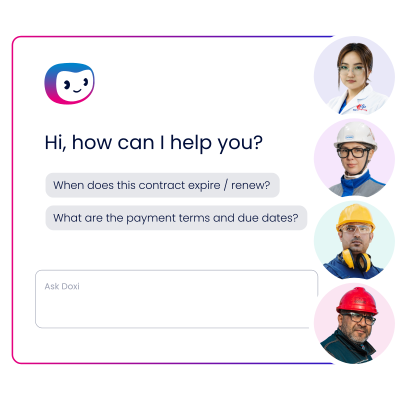
Whether it's managing grid connection files, automating approval workflows, or connecting GIS and ERP data with customer service: electricity providers face growing regulatory pressure and rising customer expectations at the same time.
Doxis Enterprise Content Management brings connection files, contracts, and correspondence together in one context, so teams always work from complete, current information.
From contract creation to renewal reminders and multi-level approvals: gas and district heating providers need fast, reliable access to contracts and the customer, financial, and business-partner data tied to them. Raffinerie Heide manages contracts digitally with Doxis — bundling all contract-relevant data and documents in electronic files, steering approvals via four- or six-eyes-principle workflows, and getting automatic reminders ahead of contract renewals.
Field teams, technical documentation, and regulatory reporting don't stop at the office door. Water and wastewater operators need access to plans, inspection records, and process documentation wherever their work happens. The Stadtentwässerungsbetriebe Köln (StEB) adopted mobile working with Doxis, giving field staff direct access to the records they need on site.
As municipal utility providers evolve from pure suppliers into full-service providers, they need to manage customer files, contracts, and regulated processes centrally, while proving compliance to regulators like the Bundesnetzagentur. Doxis brings customer and connection files together in one place, keeps regulated processes fully documented, and gives municipal utilities a single, audit-ready record of every business process.
Automate connection and case processes end-to-end
Speed and transparency in connection and case processes directly affect customer trust and regulatory standing. Doxis digitizes and steers these document-heavy workflows from first request to completed file.
It's an investment that pays off. Here's why:
- Up to 90% faster processing of routine document-based approvals
- 60–80% lower costs in invoice and document processing
- Up to 70% time saved in manual document handling
- Full traceability across every step, for every party involved
- Stronger audit-readiness against regulatory requirements
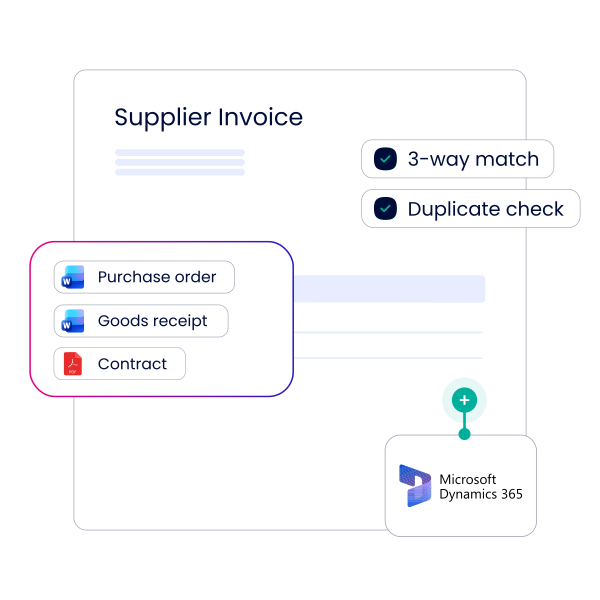
Integration in your IT landscape







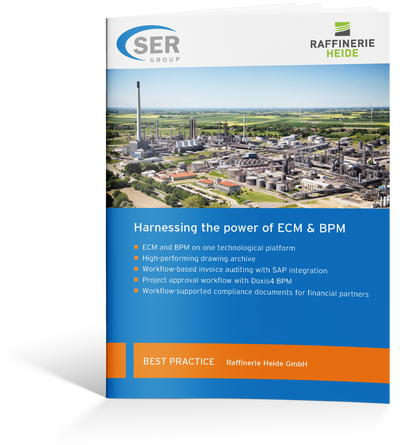
Raffinerie Heide GmbH: Harnessing the power of ECM & BPM
Raffinery Heide, a crude oil refinery, relies on the Doxis enterprise content management platform to support many areas of the company. For instance, Doxis is used to store and manage technical drawings, archive SAP data and manage electronic records. To successfully run its approval process for all types of projects, Raffinerie Heide relies on Doxis BPM.
Read now90%
Time saved
Automating document
workflows
336%
ROI in 3 years
Proven in a Forrester TEI™
study
100%
Compliant
With GDPR, ISO 9001, ISO 27001, ISO 16175-2 and IDW PS 880
Where compliance, expertise & industry recognition
come together
Secure

Compliant

Recognized
Doxis is a leader!
Gartner® Magic Quadrant™ for Document Management 2026
Partners

FAQs about ECM for utilities & energy providers
What is ECM for utility and energy providers?
Enterprise Content Management, or ECM, brings business-relevant documents, information, and processes together in one central environment. For utilities, this means records on customers, grid connections, contracts, assets, or invoices can be managed in a structured way and linked to the relevant business processes.
Which documents can Doxis manage in the utility sector?
Doxis can manage contracts, invoices, connection records, plans, measurements, inspection reports, correspondence, technical proof records, and other business-relevant documents, among others. Records can be assigned to digital files and processes, so staff find the context they need faster.
How does Doxis support grid connection processes?
Doxis can bring together documents such as connection applications, plans, approvals, photos, contracts, and correspondence in a digital grid connection file. Checks, responsibilities, and approvals can be steered through workflows, so processing status stays traceable and fewer manual handoffs are needed.
Can Doxis be connected to ERP, CRM, and GIS systems?
Yes. Doxis can be connected to existing business and specialist systems through interfaces and integrations. This makes documents available in the right customer, asset, or process context, without departments having to maintain additional isolated repositories.
How does ECM improve customer service at utilities?
Service staff can pull up customer-related contracts, invoices, letters, and other records bundled within the relevant process. This means information no longer has to be gathered from different systems first, which can speed up inquiries and service cases.
How does Doxis support compliance and retention obligations?
Doxis supports rule-based archiving, versioning, access rights, and traceable processing histories. This allows documents subject to retention requirements to be managed in a controlled way and made available on demand for internal or external audits.
Can document-based processes be automated with Doxis?
Yes. Doxis can capture and classify documents and route them to the responsible staff or departments through defined workflows. This allows checks, approvals, and releases to be steered digitally, for example, reducing recurring manual processing steps.
Is Doxis also suitable for technical documentation and maintenance?
Yes. Technical records such as plans, inspection reports, maintenance documents, photos, and measurement data can be assigned to an object, asset, or process. This gives staff structured access to the relevant documentation and lets them add new information to the existing context.
Can Doxis run in the cloud as well as on-premises?
Doxis supports cloud, on-premises, and hybrid deployment models. This lets utilities adapt the platform to their existing IT architecture and internal requirements for operations and data storage.
What's the difference between Doxis and a simple document repository?
A plain document repository stores files and makes them findable. Doxis also connects documents to business data, digital files, workflows, permissions, and archiving rules, so information can be used and processed directly within the relevant business processes.
More about ECM for utilities & energy providers


How can we help you?
+49 (0) 30 498582-0Your message has reached us!
We appreciate your interest and will get back to you shortly.