

Best compliance management software in 2026: Top 6 ECM platforms compared
|
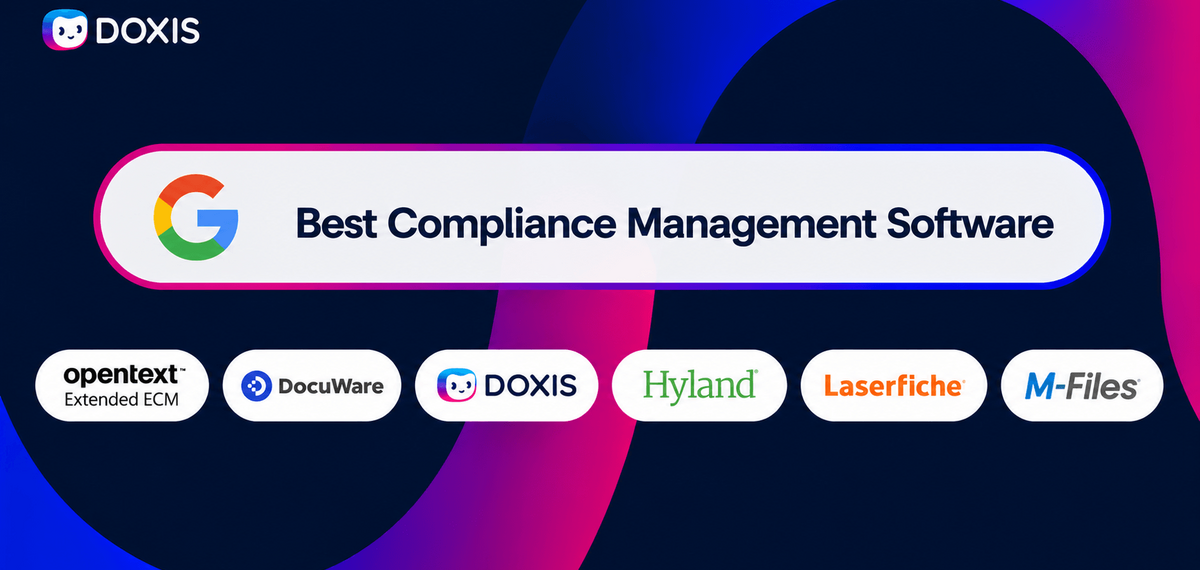
The best compliance management software doesn't just document policies, it controls how information moves through the business. Compliance failures rarely happen because an organization lacks policies. They happen because documents, approvals, and business processes fall outside controlled workflows.
The consequences can be expensive. US enterprises paid an average of $10.22 million per data breach in 2025, the highest regional average recorded globally, according to IBM's Cost of a Data Breach Report 2025.
Regulatory enforcement is equally costly: in fiscal year 2024, the U.S. Securities and Exchange Commission (SEC) imposed more than $600 million in recordkeeping penalties across more than 70 firms.
Why Document Governance Matters
Together, these figures point to a broader challenge: compliance depends on controlling how information moves through the business, not simply documenting policies.
Documents stored in shared drives without version control, approvals completed over email, and retention schedules managed in spreadsheets are the conditions auditors uncover and regulators penalize.
The right compliance management software eliminates these gaps by embedding governance directly into document workflows instead of relying on manual processes.
This guide explains how compliance management software works, what capabilities matter most in regulated environments, and compares six leading ECM platforms based on those criteria.
Key takeaways
Each platform below takes a different route to compliance, ranked by how completely it enforces governance across the document lifecycle:
- Doxis: Compliance built into the document lifecycle, with AI-powered automation and native SAP, Salesforce, and Microsoft 365 integration
- OpenText Extended ECM: SAP-embedded content management with DoD 5015.2-certified records management
- Hyland OnBase: Industry-specific compliance for healthcare and insurance through Epic and Guidewire integrations
- M-Files: Metadata-driven compliance with native Microsoft 365 integration
- Laserfiche: Records management and low-code workflow automation with published per-user pricing
- DocuWare: Cloud-first document management with compliance features across all cloud tiers
Comparison of the best compliance management software in 2026
|
Vendor |
Deployment |
Compliance strengths |
Pricing |
|
Doxis |
Cloud, on-premises, hybrid |
IDW PS 880, ISO 16175-2, ISO/IEC 27001, SOC 1/2/3 cloud services |
On request |
|
OpenText Extended ECM |
Cloud, on-premises |
DoD 5015.2 records management |
On request |
|
Hyland OnBase |
Cloud, on-premises |
SOX and HIPAA retention controls |
On request |
|
M-Files |
Cloud, on-premises |
FDA 21 CFR Part 11, ISO 27001, SOC 2 |
On request |
|
Laserfiche |
Cloud, on-premises |
Records lifecycle management, legal holds |
Published per-user tiers |
|
DocuWare |
Cloud, on-premises |
HIPAA, SOX, GDPR support |
On request |
What is compliance management software?
Compliance management software (CMS) helps you document, enforce, and prove adherence to regulatory and internal requirements. In an ECM platform, every document follows a controlled lifecycle: captured through a defined process, stored with enforced access rights, changed only through approved workflows, and retained or deleted on schedule.
The 6 best compliance management software platforms
Not every compliance management platform takes the same approach to governance, automation, and records management.
The following comparison highlights six leading ECM platforms, outlining their strengths, limitations, and the types of organizations they are best suited for.
1. Doxis
Doxis, is an AI-first ECM and Intelligent Content Automation platform that unifies document management, workflow automation, contract lifecycle management, and compliant archiving on a single architecture.
Doxis has been named a Leader in the Gartner Magic Quadrant for Document Management in both 2024 and 2026.
The platform covers compliance as a structural property of the system, not a module added on top.
Pros:
- Compliance built into the document lifecycle at ingestion: revision-safe archiving, role-based access control, enforced approval workflows, and full audit trails are automatic, not dependent on user behavior
- Certified for GDPR, GoBD, MaRisk, HGB, ISO, and SOC, with IDW PS 880 and ISO 27001 certifications applicable to financial services, manufacturing, and regulated US environments
- Native SAP, Salesforce, and Microsoft 365 integration applies compliance controls directly inside ERP processes, eliminating the need for manual document transfer
- AI layer actively reviews contracts for compliance risks and key clause changes, and flags anomalies before documents enter a controlled workflow
Cons:
- Designed for enterprise environments, which may make it more comprehensive than smaller organizations require.
- Organizations with highly customized workflows should plan for implementation and configuration to align the platform with existing business processes.
Automate Work. Accelerate Business.
Bring together AI, ECM, and workflow automation in one powerful enterprise platform.
2. OpenText Extended ECM
OpenText Extended ECM embeds content management into SAP, Microsoft 365, and Salesforce and governs the information lifecycle from capture to disposition. It carries DoD 5015.2-certified records management and is widely deployed across government agencies and regulated enterprises.
Pros:
- Reviewers value how content links to SAP transactions and how records management applies retention and disposal rules to SAP and non-SAP content (G2)
- Feedback on Gartner Peer Insights credits the records management capabilities with meeting legislative, regulatory, and audit requirements
Cons:
- Reviewers describe initial setup and configuration as complex, with a notable learning curve that needs training (G2)
- According to G2 reviews, support is inefficient, whether it comes from a partner or from OpenText directly
- Gartner Peer Insights feedback notes that metadata on older document revisions cannot be changed or corrected later
Pricing: On request, based on modules, users, and deployment model.
3. Hyland OnBase
OnBase is an integrated ECM suite that combines document management, business process management, case management, and records management. Its integrations with Epic and Guidewire make it a common choice for healthcare and insurance compliance.
Pros:
- Reviewers praise how customizable the platform is, letting teams build tailored solutions for a wide range of processes (G2)
- Reviewers highlight configurable workflow automation, security and compliance controls, and connectors to applications such as Workday and Salesforce (G2)
Cons:
- According to Gartner Peer Insights reviews, technical support and platform modernization have declined, with development focused on new cloud products over feature parity
- Reviewers find configuration hard to navigate and note that on-premises customers still face monolithic upgrades (Gartner Peer Insights)
- Reviewers describe the pricing model as challenging, with total costs that keep climbing (G2)
Pricing: On request, sold directly and through partners.
4. M-Files
M-Files organizes content by what it is instead of where it is stored. Its metadata-driven architecture applies compliance controls dynamically, and it integrates natively with Microsoft 365.
Pros:
- Gartner Peer Insights reviews praise the metadata architecture for finding documents by attributes such as project code, document type, or status, without navigating folders
- Reviewers highlight automated approval workflows for documents such as contracts and tight integration with Microsoft 365 and Outlook (Gartner Peer Insights)
Cons:
- Reviewers describe a steep learning curve before the metadata model works at its best (Gartner Peer Insights)
- According to Gartner Peer Insights feedback, the new UI still lacks classic-client features, such as desktop shortcuts and folder search within views
- Reviewers rate the mobile app and bulk document handling as underdeveloped (Gartner Peer Insights)
Pricing: On request, subscription-based.
5. Laserfiche
Laserfiche is an ECM and process automation platform for managing documents, automating workflows, and strengthening information governance. It is used across government, education, financial services, and healthcare.
Pros:
- Reviewers praise the forms and workflow automation for simplifying document routing and approvals (G2)
- G2 reviews describe it as a strong fit for automation and retention in records-heavy work
Cons:
- Reviewers find Quick Fields hard to learn, with a steep curve and a need for coding knowledge (G2)
- According to Gartner Peer Insights reviews, the cloud service has had growing pains, including downtime and a slow API
- Reviewers say some modules and add-ons are costly and that per-user pricing adds up quickly (Capterra)
Pricing: Published per-user tiers, with cloud plans starting at around $50 per user per month. Records lifecycle management and legal holds sit in the Business tier, which requires a 25-user minimum.
6. DocuWare
DocuWare is a cloud and on-premises document management platform known for fast deployment and intelligent OCR indexing. Its compliance features work without enterprise-level implementation effort.
Pros:
- Reviewers rate search and document retrieval highly, with files located quickly across large volumes (G2)
- Reviewers highlight intelligent indexing and workflow automation that consolidate files and cut manual data entry (G2)
Cons:
- Reviewers describe setup, administration, and deeper configuration as clunky, especially for advanced workflows (Capterra)
- Feedback on G2 describes the customization process as complex to understand
- Reviewers note that the platform lacks the feature depth that more complex workflows require (G2)
Pricing: On request, sold mainly through partners.
Why businesses struggle with compliance management
Most compliance gaps come from everyday document handling, not from a lack of policy. You write a policy, approve it, and store it. Then documents travel by email, working copies land on personal drives, and reviews happen in conversations that leave no record.
When an auditor asks for proof that a specific version was approved on a specific date, the answer becomes uncertain. At scale, retention schedules drift out of sync with real document volumes, and ad hoc permissions grow inconsistent across departments.
This is where document control earns its place. Regulators expect you to show that controls work inside daily processes:
- SOX: Documented controls over financial records, including approval histories and change tracking
- HIPAA: Secure access logs and documentation for electronic protected health information
- FDA 21 CFR Part 11: Electronic records and signatures that are traceable, auditable, and protected against unauthorized changes
- GDPR: Personal data kept only as long as needed, then deleted in a verifiable way
Whatever the regulation, you need complete, trustworthy records of how each document was created, reviewed, approved, and retained. That is the core of audit-proof archiving.
A GRC platform tracks whether your controls are documented. ECM-based compliance software enforces them at the document and workflow level, so the two work best together.
What to look for in compliance management software
The strongest platforms apply governance automatically across the document lifecycle. Use these capabilities as your shortlist criteria:
- Audit trails: A tamper-evident log of every view, edit, approval, and deletion
- Version control: Every prior version preserved, with a traceable change history
- Retention management: Automated retention schedules with legal holds and compliant disposal
- Access control: Role-based permissions backed by SSO and MFA
- Workflow automation: Approvals and reviews routed, signed off, and logged inside the platform
- Enterprise integrations: Governance that reaches SAP, Salesforce, and Microsoft 365 document management, including SAP archiving during an S/4HANA move
- Certifications and standards: SOC 1/2/3, ISO 27001, ISO 16175, and ISO 9001 as evidence of mature security and records practices
- Deployment options: Cloud, on-premises, and hybrid to match your security and regulatory constraints
Weigh total cost of ownership too. Budget for implementation, integrations, training, and ongoing administration alongside the license. If you are shortlisting records-specific platforms, our comparison of the best records management software goes deeper on retention and disposition.
How Doxis delivers compliance management end-to-end
Doxis closes the gap between policy and practice by enforcing compliance inside the document lifecycle. The platform applies controls from the moment a document enters the system, so procedures run the same way every time.
Banks and insurers use it for compliant financial services records and claims and policy files.
Manufacturers rely on it for quality and product documentation, and logistics companies use it to capture and verify freight and customs documents.
Every stage is built to strengthen governance while cutting manual effort:
- Revision-safe archiving: Every document version preserved with a complete change history, backed by audit-proof storage
- Automated workflows: Documents routed through predefined review and approval steps, with every decision and escalation recorded
- Granular access control: Only authorized people can view, edit, or approve, and every access event is logged
- AI-powered document intelligence: Incoming documents classified, key data extracted, and anomalies flagged before they move further
- Automated retention management: Retention periods applied by document type, with deletion locks for pending litigation and GDPR-compliant deletion for SAP data
- Verifiable AI answers: Ask Doxi links every answer to the exact clause it came from, which helps legal and compliance teams verify results in one click
If your compliance records still sit in OpenText Documentum or IBM FileNet, you don't need a big-bang cutover. Doxis supports step-by-step migration during operation, so audit evidence stays accessible throughout.
The results are measurable. In the Forrester Total Economic Impact study of Doxis, SEW-EURODRIVE achieved a 336% ROI with payback in under six months.
Automated content-centric workflows saved up to 90% of processing time, worth €6.1 million over three years. Centralized document management added €9.6 million in end-user productivity, and Forrester noted that the transparent editing history reduced audit effort.
Request a personalized demo to see how Doxis enforces document governance across SAP, Salesforce, Microsoft 365, and the rest of your business systems.
Automate Work. Accelerate Business.
Bring together AI, ECM, and workflow automation in one powerful enterprise platform.
FAQs on compliance management software
What is compliance management software?
Compliance management software helps you enforce and demonstrate adherence to regulatory and internal requirements. In an ECM platform, this covers audit trails, version control, workflow automation, access controls, and retention management across the document lifecycle.
How does ECM-based compliance software differ from a GRC platform?
GRC platforms manage risks, controls, and compliance programs at the oversight level. ECM platforms manage the documents, records, and workflows those controls depend on and produce the audit evidence behind them.
What is the difference between compliance management software and document management software?
Document management software focuses on storing and organizing information. Compliance management software adds governance capabilities such as audit trails, workflow enforcement, role-based access controls, and automated retention policies to help organizations demonstrate compliance during audits.
Can compliance management software integrate with SAP?
Yes. Many enterprise platforms integrate with ERP and business applications to extend governance across business processes. Doxis offers native integration with SAP ERP and SAP S/4HANA, while other vendors provide varying levels of SAP connectivity depending on their platform and deployment model.
Is SAP document management still important when moving to SAP S/4HANA?
Yes. Moving to SAP S/4HANA does not eliminate the need for document management. Organizations still need to manage invoices, contracts, HR records, customer correspondence, engineering documents, and other business content that supports SAP processes. A document management platform helps ensure these documents remain searchable, compliant, and connected to SAP business transactions while supporting workflow automation and long-term archiving.
Which certifications and standards does Doxis support?
Doxis is built for regulated environments and is backed by internationally recognized certifications and standards, including SOC, ISO, and IDW PS 880. These certifications reflect established practices for information security, records management, and governance.
How does Doxis help organizations prepare for audits?
Doxis creates a complete audit trail throughout the document lifecycle by automatically recording document versions, approvals, access events, and workflow actions. Combined with revision-safe archiving and automated retention policies, this helps organizations produce reliable audit evidence more efficiently.
Does Doxis use AI for compliance management?
Yes. Doxis uses AI to classify documents, extract business data, identify anomalies, and surface potential compliance risks before documents continue through business workflows. This reduces manual effort while improving consistency and visibility across document-centric processes.



How can we help you?
+49 (0) 30 498582-0Your message has reached us!
We appreciate your interest and will get back to you shortly.