

Insurance fraud detection: How AI spots forged documents
|

A single altered receipt or doctored repair invoice can slip past a busy claims adjuster without a second glance.
Multiply that across thousands of claims a month, and forged documents become one of the most expensive blind spots in your operation.
According to the FBI, non-health insurance fraud costs the industry more than $30 billion a year, and much of it starts with a document that looks legitimate at first read.
Manual review cannot keep pace with the volume and sophistication of today's forgeries, especially now that generative AI makes fabricated evidence easier to produce than ever.
This guide walks you through how AI-powered insurance fraud detection identifies forged and AI-generated documents, step by step, and what that means for your claims and underwriting teams.
Key takeaways
- Forged and manipulated documents, from altered invoices to fabricated repair estimates, are a leading driver of insurance fraud losses.
- AI-powered insurance fraud detection combines image forensics, metadata analysis, and cross-document matching to catch forgeries that manual review misses.
- Copy-move analysis and pixel-level inspection reveal digital tampering invisible to the naked eye.
- Generative AI has introduced a new fraud category: fully synthetic documents that require dedicated detection methods to catch.
- Doxis reduces document fraud by up to 67% by embedding these checks directly into your document workflows, so suspicious claims are flagged before payout.
What is AI-powered insurance fraud detection?
AI-powered insurance fraud detection uses machine learning and image forensics to identify forged, altered, or AI-generated documents submitted with insurance claims or applications.
It analyzes image metadata, pixel patterns, and cross-references data across multiple documents to flag inconsistencies a human reviewer would likely miss, all before a claim reaches final approval.
How AI detects forged documents: Step by step
Hey Doxi, how does AI detect forged documents in Insurance Fraud Detection?
Each of the steps below examines a document from a different angle, catching a different type of manipulation along the way.
Step 1: Automated document capture and digitization
Every claim starts with intake, whether the document arrives as a scanned PDF, a photo from a mobile app, or an email attachment.
AI-powered capture converts these inputs into a standardized digital format regardless of source, so downstream fraud checks can run consistently across your entire claims volume.
This step also classifies the document type automatically, whether it is a repair estimate, medical bill, or proof-of-loss form.
Correct classification matters because different document types trigger different fraud checks later in the process.
Step 2: Copy-move and image manipulation analysis
Copy-move analysis detects when a section of an image has been duplicated and pasted elsewhere within the same document, a common technique for inflating damage claims or hiding an existing flaw.
The algorithm scans for repeated pixel patterns that would be statistically improbable in an authentic, untouched image, and can pinpoint the exact coordinates of the duplicated region.
This check also catches content spliced in from a different source entirely, such as a duplicated crack in a windshield photo or a copied water stain used to exaggerate property damage across multiple claims.
Step 3: EXIF metadata inspection
Every digital photo carries embedded metadata, including the camera or device used, the timestamp, and GPS coordinates if location services were enabled.
EXIF inspection checks this metadata against the claim details for inconsistencies, such as a photo timestamped weeks before the reported incident date, and identifies which software was last used to edit the file.
Missing or stripped metadata is itself a red flag. Legitimate photos taken on a smartphone almost always carry a full metadata set, so its absence signals that an image has been edited and re-saved.
Step 4: Grayscale and pixel-level analysis
Pixel-level analysis examines the underlying data of an image rather than what appears on the surface.
It can detect compression artifacts, inconsistent lighting or shadow patterns, and resolution mismatches between a document's original content and any inserted or altered sections.
Grayscale conversion strips away color noise to reveal structural inconsistencies, such as font irregularities on a printed invoice or edited numbers on a scanned receipt, that color images can mask.
Step 5: PDF modification and font checks
Many claim documents arrive as PDFs, which have their own forgery patterns separate from photos.
This check flags structural changes to annotations, stamps, ink, and free text, along with fonts that differ from the surrounding document, a common giveaway when a total or a date has been edited after the fact.
Combined with metadata analysis, this catches a category of forgery that pixel-based image checks alone would miss, since a manipulated PDF field does not always leave a visible visual trace.
Step 6: Detecting AI-generated and synthetic documents
Generative AI has added a new layer to document fraud: entirely fabricated invoices, IDs, or damage photos that were never based on a real event.
According to Deloitte, fraud detection was cited by 35% of insurance executives as one of their top areas for new generative AI applications, reflecting how central this threat has become.
Catching synthetic documents takes two parallel approaches. The first reads AI-provenance metadata embedded in a file, such as the generator or model used to produce it.
The second detects the visual patterns that generative AI tools leave behind, patterns invisible to the eye but consistent enough for a trained model to recognize.
Running both checks alongside standard forensic analysis means a synthetic document gets flagged even when it looks clean on the surface.
Step 7: Cross-source validation and scoring
Cross-source validation compares extracted data against your internal systems and third-party reference databases, running two-way and three-way matching across a claim, its supporting invoice, and any related purchase or repair order.
Duplicate detection runs in parallel, catching the same claim document submitted more than once, a leading cause of duplicate payouts.
Each check returns its own confidence level and risk score, which are then aggregated into a single fraud-likelihood score.
That score determines whether a document flows straight through or routes to an adjuster for review, keeping the final decision with a person while removing the manual burden of reviewing every document from scratch.
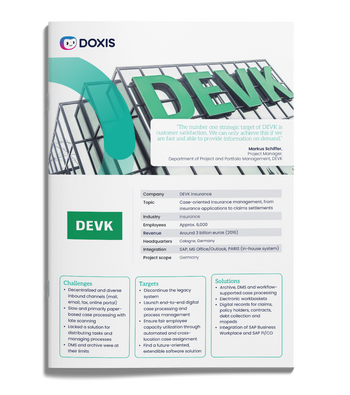
DEVK: Process-centric insurance management
Read all about how DEVK swiftly and securely manages their insurance processes.
Read nowWhy fraud detection matters for your business
Every fraudulent payout you catch is money that stays out of the loss ratio and out of the premiums your honest policyholders pay.
Beyond the direct financial impact, faster and more accurate fraud detection shortens investigation cycles, which means legitimate claims move through your pipeline without getting stuck behind manual reviews triggered by false suspicion.
Weak detection also makes you a target. Fraudsters learn which insurers are easiest to deceive and route more of their submissions there, so carriers with the thinnest defenses end up absorbing a disproportionate share of the fraud in the market.
A stronger detection stack cuts your losses today and makes your business a harder mark going forward.
Key benefits of AI-powered fraud detection include:
- Reduced payout losses from forged, altered, or AI-generated claim documents
- Faster claims cycles for legitimate policyholders, since fewer files need manual escalation
- Lower investigation costs through automated triage of high-risk documents
- Stronger compliance posture with a documented, auditable review trail
- Better fraud pattern recognition over time as detection models are refined against confirmed cases
Common use cases in insurance
Document fraud detection applies across multiple points in the policy lifecycle, not just at claims intake.
Each use case draws on the same underlying detection layers, applied to the document types your teams handle most.
Auto claims
Copy-move and pixel-level analysis catch duplicated or altered damage photos, while cross-source validation flags repair estimates that do not line up with the reported incident.
Property claims
Manipulated photos of storm, fire, or water damage are among the most common submissions for this line, and EXIF and pixel-level checks catch them before payout.
Life insurance
Forged death certificates and falsified medical records submitted with a beneficiary claim are high-value targets for fraud, and PDF modification checks catch edits that image analysis alone would miss.
Underwriting
Identity documents and income statements submitted during policy applications get the same forensic treatment as claims, catching fraud before a policy is ever issued.
Workers' compensation
Cross-checking medical bills and treatment authorizations surfaces inconsistencies between what was billed and what was actually authorized.
How Doxis helps you catch fraud before it costs you
Reviewing every claim document by hand is not sustainable at scale, and it leaves your business exposed to exactly the kind of forgery that AI is built to catch.
Doxis addresses this through its document fraud detection capabilities, purpose-built to verify supporting documents on claims before a payout is approved and to route high-risk claims automatically for adjuster review.
The platform runs every incoming document through layered forensic checks: metadata and EXIF analysis, copy-move and pixel-level analysis, PDF modification and font checks, duplicate detection, cross-source validation, and AI-generated content detection.
Each check returns a confidence level and risk score, aggregated into a single fraud-likelihood score you can route on in real time. Doxis is recognized as a Leader in the Gartner® Magic Quadrant™ for Document Management 2026.
Key benefits of using Doxis for insurance fraud detection include:
- Document fraud reduced by up to 67% through layered forensic and cross-source checks
- Real-time fraud-likelihood scoring that routes high-risk claims to review automatically
- Detection built for insurance-specific document types, from claim evidence to policy applications
- GDPR and ISO 27001 compliant processing with full audit trails
- Seamless integration into your existing claims and policy administration systems through 200+ connectors
- One unified Intelligent Content Automation platform instead of a standalone point solution
If forged or AI-generated documents are costing your business money and slowing down your legitimate claims, book a demo below to see how Doxis fits into your fraud detection workflow.
Automate Work. Accelerate Business.
Bring together AI, ECM, and workflow automation in one powerful enterprise platform.
FAQs on insurance fraud detection
What is the most common type of document fraud in insurance claims?
Altered or duplicated photos and inflated repair estimates are among the most common forms, created through copy-move manipulation or simple photo editing tools.
Can AI detect fraud in scanned paper documents, not just digital files?
Yes. AI-powered capture digitizes paper documents first, then applies the same forensic checks, including pixel-level and grayscale analysis, used on digital files.
How does AI tell the difference between a genuine edit and fraud?
The system flags statistical anomalies, such as duplicated pixel patterns or missing metadata, that are highly improbable in an authentic document. Those cases route to a human investigator for a final decision rather than an automatic determination.
Is AI fraud detection accurate enough to replace human investigators?
No. AI narrows down which documents need attention and surfaces the specific anomaly, but a human investigator still confirms the final fraud determination in a human-in-the-loop workflow.
What is EXIF metadata and why does it matter for fraud detection?
EXIF metadata is information embedded in a digital photo, including the device used, timestamp, and location. Inconsistencies or missing metadata indicate a photo has been edited or misrepresented.
Can AI detect documents created entirely by generative AI tools?
Yes. Detection methods that read AI-provenance metadata and recognize the visual patterns typical of generative-AI tools can flag fully synthetic documents, in addition to catching traditional edits to real ones.
How does document fraud detection fit into a broader claims automation strategy?
It works best as part of an end-to-end intelligent document processing workflow, where capture, classification, validation, and fraud detection all happen within the same platform instead of separate disconnected tools.
Does fraud detection software integrate with existing claims management systems?
Yes. Platforms like Doxis integrate through open APIs, allowing fraud detection to run within your existing claims and policy administration systems rather than requiring a separate standalone platform.



How can we help you?
+49 (0) 30 498582-0Your message has reached us!
We appreciate your interest and will get back to you shortly.