

What is federated search? Definition, benefits, and how it works
|
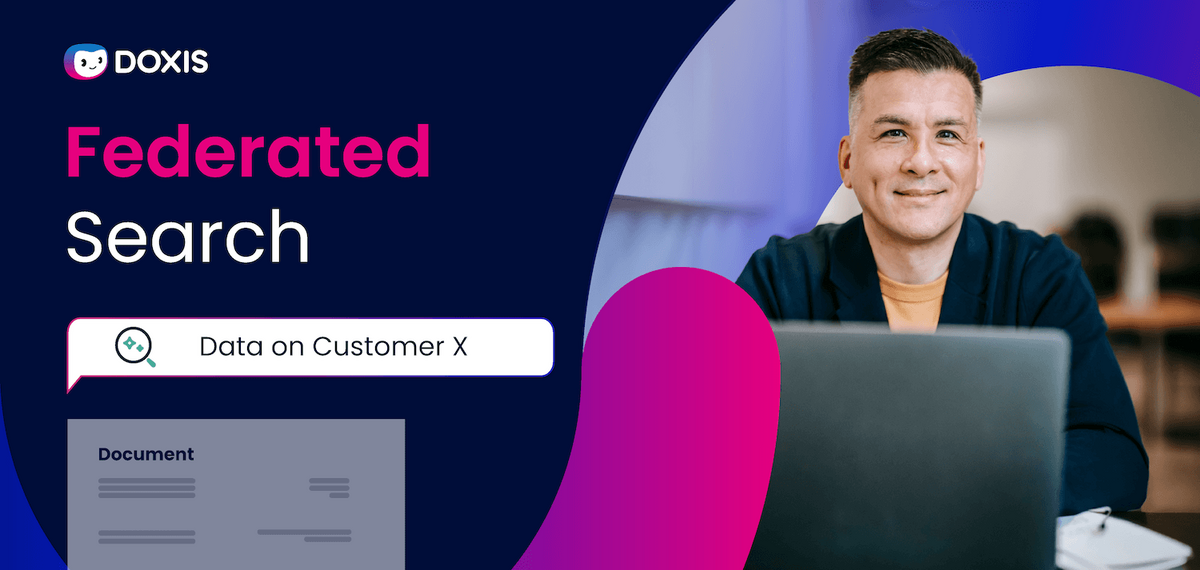
Your customer data lives in the CRM. Contracts sit in one archive, invoices in another, and product specs are buried somewhere in a shared drive nobody fully trusts. Every one of those systems has its own search bar, and none of them talk to each other.
According to McKinsey, employees spend 1.8 hours a day, roughly 9.3 hours a week, just searching for and gathering information. Most of that time is lost jumping between systems that were never built to work together.
Federated search fixes this without forcing you to migrate a single file. This guide explains what it is, how it works, and where it fits next to indexed search and AI-powered retrieval.
Key takeaways
- Federated search runs one query across multiple separate systems and returns a single, combined result set, without copying data into a central index.
- Employees lose close to two hours a day to scattered information.
- Federated search queries source systems live, trading some ranking depth for freshness and zero migration risk. Indexed search does the opposite.
- The most common use cases are a 360° customer view, faster product development, and extending intranet search across scattered enterprise systems.
- Doxis connects federated search directly to its Content Service Bus, linking more than 100 external systems without migration, and layers AI-powered search on top.
What is federated search?
Federated search is a search technology that runs a single query across multiple separate systems, such as databases, applications, and repositories, and returns one combined set of results. Instead of copying everything into a central index, it queries each connected source directly and merges the results in real time, so your data stays exactly where it already lives.
How does federated search work?
Conventional search relies on an index: a system crawls your content ahead of time and stores a searchable copy in one place. Federated search skips that step. When you run a query, it fans out to every connected source at once, collects what each one returns, and presents a single, deduplicated list back to you.
This has a practical side effect: permissions travel with the query. A well-built federated search layer checks access rights against each connected system at search time, so you only ever see results you're actually authorized to view, no separate permissions sync required.
It also means the results stay current. There's no lag between when a document changes and when it shows up in search, because nothing was cached. If a source system changes through a migration or an update, updating the connector is usually enough to keep search working.
Federated search vs. indexed search: which do you need?
These two approaches solve the same problem in opposite ways, and most enterprises end up needing both.
Indexed search pre-crawls your content and builds a central, searchable copy. That copy is what makes indexed search fast and lets it rank results with real precision. The tradeoff: you're maintaining a second copy of your data, and that copy is only as current as your last crawl.
Federated search never builds that copy. It queries live, so results are always fresh and sensitive data never leaves its source system, which matters in regulated industries where duplicating data raises its own compliance questions. The tradeoff runs the other way: without a unified index, relevance ranking across different sources is harder to get right, and query performance depends on how fast the slowest connected system responds.
In practice, you rarely pick one architecture and stop there. Fast-moving data (a live ERP feed, an actively edited contract) suits federation. Stable, high-volume content that benefits from deep ranking suits indexing. The strongest setups run both side by side, adding a semantic or AI layer on top to route each query to whichever method fits.
Want the bigger picture on AI-powered document workflows?
Search is one piece of it. See how AI and automation streamline six document-intensive processes in Solving Real Business Challenges with Doxis AI.dp.
Read nowKey benefits of federated search
- No data migration: Content stays exactly where it already lives, which cuts both project risk and IT overhead.
- Real-time results: Because nothing is cached, what you search is what actually exists right now.
- Lower storage costs: You're not paying to store and maintain a duplicate index of everything you already have.
- Faster cross-system decisions: Sales, support, and operations teams stop switching tabs to piece together one answer.
- Built-in access control: Permissions are checked against the source system at query time.
Common use cases for federated search
Federated search shows up wherever information is scattered but migrating it isn't realistic. Three patterns come up most often.
A 360° view of customer data
Sales, marketing, and support usually run on separate systems, often stitched together through CRM integration. Federated search pulls customer data, interactions, and transaction history into one view without touching any of the underlying applications. That gives sales reps the full picture in seconds instead of five open tabs, which translates directly into faster, better-informed conversations.
Faster product development
R&D data is usually scattered across specialized systems that don't export cleanly. Federated search lets product and engineering teams query current data from those systems directly, so decisions are based on what's actually true today.
Extending intranet and enterprise search
Chances are you already run some form of intranet search. Federated search extends enterprise search to reach further, pulling in additional repositories the intranet was never connected to, without rebuilding the intranet itself.
Challenges and limitations of federated search
Federated search solves a real problem, but it isn't a drop-in fix. A few things to plan for before you commit to it:
- Connector overhead: Every source system needs its own connector, and maintaining a growing list of them takes ongoing effort as source systems change.
- Uneven relevance ranking: Without a shared index, ranking results consistently across sources with different data structures is genuinely hard to get right.
- Latency from the slowest system: A query is only as fast as the slowest connected source, so one sluggish legacy system can drag down the whole search experience.
- Governance complexity: Access rights, data classification, and audit requirements all need to be enforced consistently across every connected system.
That's exactly why federation deserves a deliberate plan: decide which sources to federate, which to index, and where the line sits. Getting that split right is usually what separates a search project that gets adopted from one that quietly gets abandoned.
Federated search and Doxis
Doxis integrates content federation directly into its Content Service Bus, the central component that handles metadata and orchestration across the platform. Through flexible connectors, Doxis connects to more than 100 external systems, giving you a single, client-independent search across your IT landscape without migrating anything into Doxis first. New connections can go live quickly, whether the goal is enriching metadata, feeding a decision, or just cutting the number of tabs someone has open.
That's one part of a larger platform. Doxis unifies ECM, intelligent document processing, and AI-powered search, so federated results, indexed content, and the semantic understanding behind Doxis Superhuman Search all show up in one place. Doxis is recognized as a Leader in the Gartner® Magic Quadrant™ for Document Management 2026, and a Forrester Total Economic Impact™ study found a 336% ROI for SEW-EURODRIVE, a manufacturer now searching 60 years of history and getting results back in milliseconds.
With Doxis, you get:
- Federated access to 100+ external systems without data migration
- A single, unified search across both federated and indexed content
- AI-powered semantic search on top of both, through Doxis Superhuman Search
- Metadata enrichment that improves search relevance over time
- Enterprise-grade access control enforced at query time
- One platform for ECM, document processing, and process automation
Ready to see what federated search looks like inside a unified content platform? Request a free demo with Doxis.
Automate Work. Accelerate Business.
Bring together AI, ECM, and workflow automation in one powerful enterprise platform.
FAQ about federates search
What is federated search in simple terms?
Federated search lets you type one query and pull results live from several separate systems at once.
How is federated search different from enterprise search?
Enterprise search is the broader goal of making information findable across an organization. Federated search is one method for achieving it, alongside indexed search and hybrid approaches.
Is federated search the same as indexed search?
No. Indexed search pre-crawls content into a central, searchable copy. Federated search queries source systems live and never builds that copy.
What are the main benefits of federated search?
No data migration, real-time results, lower storage costs, and access control enforced at the source.
What are common use cases for federated search?
A 360° view of customer data across CRM and support systems, faster access to R&D and product data, and extending intranet search to reach more repositories.
What are the challenges of implementing federated search?
Connector maintenance, inconsistent relevance ranking across sources, latency from slower systems, and governance that has to stay consistent across every connected system.
Does federated search work with SAP and other enterprise systems?
Yes. Federated search architectures use adapters or connectors built for specific systems, including ERP platforms like SAP, CRMs, and intranets.
How does Doxis support federated search?
Doxis connects federated search to its Content Service Bus, linking more than 100 external systems through adapters, and combines it with indexed content and AI-powered semantic search on one platform.



How can we help you?
+49 (0) 30 498582-0Your message has reached us!
We appreciate your interest and will get back to you shortly.