

Enterprise information management: turning scattered content into a governed, AI-ready asset
|

The same customer file lives in a CRM, an email inbox, an ERP, and a shared drive, and none of the four copies agree with each other. That's not an information shortage. It's a scattering problem, and according to the AIIM/Deep Analysis Market Momentum Index Survey 2025, managing unstructured data across a growing number of systems is now one of the defining obstacles to putting AI to work in the enterprise.
Enterprise information management (EIM) governs an organization's structured and unstructured content, documents, records, emails, and data, as one connected asset. It applies capture, classification, storage, retention, and retrieval under a single governance model, so information stays findable and compliant no matter which system it started in.
EIM overlaps with enterprise content management and records management, but it's the broader umbrella. It covers data that never becomes a formal document at all, and it accounts for how AI systems now consume that information to answer questions and act on a business's behalf. This article covers what EIM includes, how it differs from adjacent disciplines, the mechanics of running a program, and where AI actually changes the equation.
Key takeaways
- Enterprise information management governs the full lifecycle of structured and unstructured content across every system it lives in, from a core repository out to CRM, ERP, and email
- EIM sits above ECM, records management, and IDP as the governance layer that connects what those disciplines do individually
- Scattered, ungoverned information is now a direct AI-readiness problem, since a model can only be as reliable as the content it's grounded in
- A defensible EIM program depends on retention scheduling, audit trails, and access controls applied the same way across every connected system
- AI contributes automated classification, metadata extraction, and natural-language search, while governance and human oversight retain the decisions that carry legal or financial weight
- Doxis unifies ECM, intelligent document processing, and AI-powered search on one platform, so information stays connected across every system it touches
What is enterprise information management?
Enterprise information management is the set of policies, processes, and technologies an organization uses to capture, organize, govern, and use its information, regardless of format or which system created it. That covers formal records, working documents, structured data in business applications, and the metadata AI systems need to reason over that content accurately.
An EIM program covers three connected layers:
- Capture and organize: bringing content in from email, scanned paper, forms, and system exports, then classifying and indexing it consistently
- Govern: applying retention schedules, legal holds, access controls, and audit trails so information stays compliant and defensible
- Activate: making governed information searchable and connected to business processes, without duplicating it into an ungoverned copy somewhere else
A well-organized document repository that isn't connected to retention policy covers only one piece of the puzzle. The same goes for a retention policy that only reaches records in one system while the same information sits ungoverned in email and shared drives. All three layers have to work together, or the gaps become the risk.
How is enterprise information management different from plain document management?
Document management focuses on storing and versioning individual files. Enterprise information management is broader: it governs content and data across every system it lives in, from CRM to ERP to email, under one consistent policy, and it accounts for how that information feeds AI-driven processes as well as human readers.
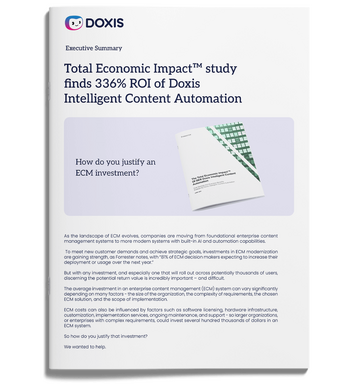
The Total Economic Impact™ of Doxis
See the financial model behind a 336% ROI, a payback period under six months, and €17.37 million in present-value benefits from consolidating content and information management on Doxis.
Read nowEnterprise information management vs. adjacent disciplines
The terminology in this space overlaps heavily. Here's how EIM relates to the practices it's most often confused with:
|
Discipline |
Primary focus |
Where it fits under EIM |
|
Enterprise Content Management (ECM) |
Storing, versioning, and securing documents and content |
The repository and content-services layer EIM governs |
|
Records Management |
Lifecycle control of declared records: retention, legal hold, disposition |
The compliance and governance layer within EIM |
|
Intelligent Document Processing (IDP) |
AI-driven capture, classification, and data extraction from incoming documents |
The automation layer that feeds clean content into EIM |
|
Enterprise Information Management (EIM) |
Governing structured and unstructured content and data across all systems as one connected asset |
The umbrella that ties the disciplines above together |
ECM and records management define how content is handled once it's inside a governed system. IDP handles how content gets into that system with minimal manual work. EIM is the strategy that ties those pieces into one enterprise-wide approach, so a governed repository isn't surrounded by ungoverned content everywhere else in the business.
How enterprise information management works: step by step
Hey Doxi, how does enterprise information management work, step by step
1. Capture information from every source
Content enters the business through email, scanned mail, web forms, EDI feeds, and system integrations. Standardized intake keeps information from piling up in personal inboxes and local folders, which is where most governance failures start.
2. Classify and extract metadata
Incoming content gets classified by type and business context, with key metadata pulled out automatically: a vendor name and invoice number, a contract's expiration date, a customer ID. Intelligent document processing does the heavy lifting here, reading semi-structured and unstructured documents and populating the metadata that governance rules depend on.
3. Apply governance rules
Classified content gets a retention schedule, access permissions, and, when relevant, legal hold status. These rules have to apply consistently whether the content lives in the core repository, a connected system like SAP or Microsoft 365, or an email archive.
4. Connect information to business processes
Governed information should flow directly into the workflows that use it: invoice approval, contract review, case handling. This is where EIM overlaps with business process management.
5. Make information findable and usable
The final step is retrieval. Employees and AI agents both need to find the right information quickly, with results limited to what they're authorized to see. Enterprise search, including AI-powered document search, closes the loop between governance and everyday usability.
Enterprise information management governance
Governance is what separates enterprise information management from a lot of organized folders. A defensible program needs three things in place, consistently, across every connected system:
- Retention scheduling tied to record type and jurisdiction, keeping information exactly as long as regulation or business need requires
- Access control that limits who can view, edit, or export information based on role, enforced the same way whether someone browses manually or asks an AI assistant a question
- Audit trails that log every access, edit, approval, and disposition action, producing a tamper-proof record for a regulatory audit or a legal discovery request
IT owns the technical implementation: connectors, storage, retention automation. Business and compliance teams own the policy: what gets retained, for how long, and who's authorized to see it. An EIM program works only when both sides apply the same rules to the same content, everywhere it lives.
KPIs for measuring enterprise information management success
Track these core KPIs to assess the effectiveness, maturity, and business impact of your enterprise information management strategy.
- Time to retrieve information: how long it takes an employee, or an AI system acting on their behalf, to get a direct, authoritative answer
- Percentage of content under active governance: the share of enterprise content with a defined retention schedule and access policy
- Touchless classification rate: the share of incoming content classified and tagged with metadata automatically, without manual review
- Audit findings tied to information governance: a declining trend is a direct measure of program maturity
- Duplicate or conflicting records: how often the same information exists in multiple, inconsistent versions across systems
Automation: where rules are enough and where AI adds value
Rule-based automation handles the parts of an EIM program where the logic is fixed: applying a retention schedule once a document type is known, routing an invoice to the right approver above a set amount, enforcing access permissions by role. These are deterministic decisions, and rules handle them reliably.
AI earns its place where the input is messy: classifying an inbound document with no consistent template, extracting data from a handwritten form, answering a natural-language question by pulling the right passage out of thousands of documents. The AIIM/Deep Analysis Market Momentum Index Survey 2025 puts the average enterprise automation rate for document processing at 63% today. AI-assisted classification and extraction are what's closing that remaining gap, alongside the rules handling everything deterministic.
Implementation tip: start an EIM and AI rollout with one high-volume, well-defined content type. Incoming invoices or HR onboarding documents are common starting points, before governance and AI-assisted classification expand to less structured content.
How Doxis approaches enterprise information management
Doxis brings the layers of enterprise information management together on one platform, so capture, governance, and activation don't require separate tools kept in sync by hand:
- Enterprise content management as the governed repository: retention scheduling, legal holds, role-based access, and immutable audit trails, applied consistently to content native to Doxis and to content connected from SAP, Microsoft 365, and Salesforce
- Intelligent document processing (Doxis AI.dp) for capture and classification: AI-driven extraction turns incoming invoices, contracts, and forms into governed, metadata-rich content automatically
- Doxis Superhuman Search for activation: natural-language, AI-powered search that respects the same access permissions and audit requirements as the underlying repository, giving employees and AI agents source-backed answers
- Records management built into the platform, so retention and disposition apply the same way whether content was captured yesterday or migrated from a legacy archive
DHL Express runs its archive on Doxis at a scale that shows what enterprise-grade EIM looks like in practice: 8.5 billion documents archived, with roughly 130 million more added every month, all under the same governance model. In Forrester's Total Economic Impact™ study of Doxis, one customer reached a 336% return on investment over three years with payback in under six months, driven largely by consolidating previously scattered content and workflows onto a single governed platform.
Enterprise information management is the governance strategy that keeps content and data consistent, compliant, and usable no matter which system they live in, including the AI systems now built on top of them. Consistent capture, applied governance, and connected activation determine whether an organization's information is an asset AI can be trusted to use, or a liability waiting to surface in an audit.
Automate Work. Accelerate Business.
Bring together AI, ECM, and workflow automation in one powerful enterprise platform.
FAQs on enterprise information management
What is enterprise information management (EIM)?
Enterprise information management governs an organization's structured and unstructured content and data as one connected asset, applying consistent classification, retention, access control, and retrieval rules regardless of which system the information started in. Doxis supports EIM by unifying content governance, capture, and AI-powered search on a single platform.
How is EIM different from enterprise content management (ECM)?
ECM stores, versions, and secures documents inside a repository. EIM is the broader governance strategy that keeps content and data consistent across every system they touch, including CRM, ERP, and email. Doxis treats ECM as one governed layer within a wider EIM approach.
Does enterprise information management include records management?
Yes. Records management, covering retention scheduling, legal holds, and defensible disposition, is the compliance-focused piece of a broader EIM program. Doxis includes records management as a native platform capability.
How does AI change enterprise information management?
AI adds automated classification, metadata extraction, and natural-language search to an EIM program, closing the gap on content too unstructured for fixed rules to handle. Doxis applies AI to these tasks while keeping governance rules, including retention, access, and audit trails, in force over every AI-assisted action.
What happens to information governance when a company uses AI search or AI agents?
Governance rules need to extend to AI-generated answers, or an AI assistant can surface information a user wouldn't normally be authorized to see. Doxis Superhuman Search applies the same access permissions and audit requirements to AI-generated answers as to manual document access.
Can enterprise information management work across systems like SAP, Microsoft 365, and Salesforce?
Yes. An EIM program is only as strong as its weakest ungoverned system. Doxis applies consistent governance across content connected from SAP, Microsoft 365, Salesforce, and other enterprise systems, without requiring that content to be migrated first.
What does it cost to implement enterprise information management software?
Cost depends on data volume, the number of systems being connected, and how much AI-assisted classification and extraction the program requires. Doxis pricing is scoped to the specific systems and content volume involved. Contact Doxis for a tailored quote.
Is enterprise information management relevant for compliance requirements like GDPR?
Yes. A well-run EIM program is one of the most direct ways to demonstrate compliance with regulations like GDPR, since it enforces retention, access, and audit requirements consistently across every system. Doxis builds these governance controls into the core platform.
How long does it take to roll out enterprise information management?
Most organizations start with one high-volume content type, such as invoices or HR documents, before expanding governance to the rest of the enterprise. Doxis customers commonly follow this phased approach, automating one defined process first and extending governance from there.



How can we help you?
+49 (0) 30 498582-0Your message has reached us!
We appreciate your interest and will get back to you shortly.