

France's 2026 E-Invoicing Mandate: What Changed and How to Stay Compliant
|

Your accounts payable team is still opening PDF invoices by email and keying them into SAP by hand. On 1 September 2026, that habit became a compliance gap. France's mandatory e-invoicing reform is now in force, and every VAT-registered business in the country, regardless of size, has to be able to receive electronic invoices.
According to economie.gouv.fr (2026), more than 10 million economic operators are affected by the reform. Large enterprises and ETIs (intermediate-sized companies) also have to issue e-invoices and submit e-reporting data from the same date, with SMEs, micro-enterprises, and sole traders following on 1 September 2027.
This article walks through what the mandate actually requires today, the real difference between the platforms involved, what it will require next year, and the practical steps to get your invoice processes compliant with the help of automated invoice processing.
Key Takeaways
- Since 1 September 2026, every VAT-registered business in France must be able to receive electronic invoices, regardless of size.
- Large enterprises and ETIs must also issue e-invoices and submit e-reporting data from the same date; SMEs, micro-enterprises, and sole traders have until 1 September 2027 to start issuing.
- Invoices can no longer be sent as plain PDF or email; they must be routed through a registered Plateforme Agréée (PA). The state-run Portail Public de Facturation (PPF) no longer offers this service itself; since October 2024, it only maintains the business directory and forwards data to the DGFiP.
- Failing to issue a compliant e-invoice can trigger a €50 fine per invoice, capped at €15,000 a year; missing e-reporting transmissions carry a separate €500 fine per transmission, same cap, though a first infraction corrected within 30 days is waived under Article 1737 of the French tax code.
- Rule-based automation handles matching and routing reliably; AI adds value on classification and extraction from non-standard formats, Doxis Invoice combines both to keep the process auditable.
- Accepted formats are Factur-X, UBL, and CII, all built on the EN 16931 European semantic standard.
What Is France's E-Invoicing Mandate?
France's e-invoicing mandate is a legal requirement, introduced under Article 91 of the 2023 finance law, for businesses to exchange invoices in a structured electronic format through an approved platform, rather than by PDF, paper, or unstructured email. It applies to domestic B2B transactions between VAT-registered companies and is accompanied by a separate e-reporting obligation covering transactions the mandate doesn't otherwise capture, such as B2C sales and international transactions.
PPF, Plateforme Agréée (PA), and Solution Compatible (SC): Who Does What
This is the part of the reform most likely to trip up a business relying on outdated information — including earlier drafts of this article. Here's the current division of roles:
| Entity | What it actually does | Can it transmit invoices to the tax authorities? |
| PPF (Portail Public de Facturation) | Maintains the central directory of VAT-registered businesses and their chosen PA; forwards tax data to the DGFiP as a data concentrator | No, it stopped issuing and receiving invoices for businesses in October 2024 |
| Plateforme Agréée (PA) | A DGFiP-registered private platform authorized to transmit, receive, and route structured e-invoices between businesses | Yes, this is the only entity legally authorized to do so |
| Solution Compatible (SC) | A billing, ERP, or ECM tool (like Doxis) that generates, extracts, and manages structured invoice data | No, must be connected to a registered PA for the transmission itself |
In practice, this means a business always needs a PA, whether it connects to one directly or through a Solution Compatible like its ERP or accounting software. Neither the PPF nor a Solution Compatible on its own can complete the actual transmission. The DGFiP dropped the PPF's free invoicing function in October 2024, judging the private ecosystem of over 70 registered Plateformes Agréées mature enough to take over — so today, registering with one (directly or through a Solution Compatible like Doxis) isn't optional, it's the only route to compliant transmission.
What the Mandate Requires, by Company Size
The rules that apply to you depend on where your business sits on France's size scale, and that scale uses four categories, not the usual two.
- Large enterprise: more than 5,000 employees and either more than €1.5 billion in revenue or more than €2 billion in total assets
- ETI (intermediate-sized company): 250 to 4,999 employees, with revenue under €1.5 billion or assets under €2 billion
- SME: fewer than 250 employees, with revenue or assets below the ETI thresholds
- Micro-enterprise: fewer than 10 employees and revenue or a balance sheet total under €2 million
| Business size | Receive e-invoices | Issue e-invoices | Submit e-reporting |
| Large enterprise / ETI | 1 September 2026 | 1 September 2026 | 1 September 2026 |
| SME / micro-enterprise / sole trader | 1 September 2026 | 1 September 2027 | 1 September 2027 |
Every category shares the same reception deadline. The gap only opens up on the issuing side, where smaller businesses get an extra year to adapt their own outgoing invoice process.
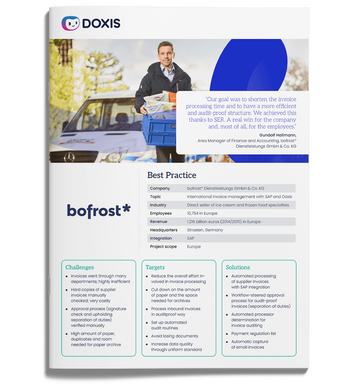
bofrost* Automates Inbound Invoice Processing with Doxis and SAP
bofrost*, a direct seller of ice cream and frozen food, used to route supplier invoices through multiple departments for manual signature and segregation-of-duties checks. With Doxis, it automated inbound invoice processing end to end in SAP, from reception to audit-ready archiving.
Read nowThe Real Cost of Non-Compliance
The fines themselves look small on paper, but the 2026 finance law raised them. Under Article 1737 of the French tax code, a business that fails to issue a compliant e-invoice faces a €50 penalty per invoice, up from €15 in the original 2023 version of the reform, capped at €15,000 a year. A separate, smaller €15 fine applies to omissions or inaccuracies in an invoice's mandatory mentions, and a missing e-reporting transmission carries its own €500 fine per transmission, also capped at €15,000 a year.
For failing to route received invoices through a registered PA specifically, the law takes a graduated approach rather than an immediate fine: the DGFiP issues a formal notice (mise en demeure) with a three-month window to comply, then a €500 fine if the situation persists, rising to €1,000 per additional quarter of continued non-compliance.
The tax authorities have described 2026 as a grace period for enforcement. Article 1737, V waives penalties for a first infraction committed in the current calendar year or the three preceding it, when it's corrected spontaneously or within 30 days of the administration's first request. In a public statement on 11 July 2026, the ministry confirmed there would be "no sanctions at the start of this reform for businesses acting in good faith that encounter a difficulty and take the necessary steps to correct it." Good faith buys time. Standing still doesn't, and the bigger cost usually shows up in what an audit finds once it starts looking: incomplete paper trails, disputes with suppliers, and an audit that takes weeks instead of days because your finance team is reconstructing invoice history by hand.
Hey Doxi, how do I actually get my business compliant?
Hey Doxi, how do I get my business compliant with France's e-invoicing mandate?
Getting compliant isn't a single project with one deadline. It's a sequence of decisions that gets harder to unwind the longer you wait, here's the order that works.
1. Confirm which obligations apply to you now
Match your business against the size categories above. Whatever you find, reception is already mandatory. Issuing and e-reporting either started with reception on 1 September 2026 or arrive on 1 September 2027, depending on your size.
2. Choose a registered Plateforme Agréée for outbound transmission
Invoices sent by email or as a plain PDF no longer count as compliant. Outbound e-invoices have to be issued and transmitted through a registered Plateforme Agréée — directly, or through a Solution Compatible connected to one. Choosing the right PA, and confirming it supports the formats you need, is a decision worth making early, before deadline pressure forces a rushed pick.
3. Make sure you can actually receive structured invoices
Reception is the obligation that applies to you today, whatever your size. That means your accounts payable process needs to take in Factur-X, UBL, or CII files and extract the structured data from them automatically, without someone retyping totals into SAP.
4. Update your invoice mentions and retention rules
The reform adds new mandatory mentions to invoices, including the transaction category and, where relevant, the full delivery address. Electronic invoices also have to be archived in their original structured format for the legally required retention period.
5. Test before volume hits
Run your first structured invoices through the full process end to end, from reception to SAP posting, before volume from your busiest supplier or customer relationship depends on it working correctly.
Common Mistakes That Lead to Penalties
Most penalty exposure comes from the same handful of decisions, repeated across thousands of French businesses working through this reform at the same time.
Treating the reception obligation as optional because you're not issuing yet. Every business, including SMEs with an issuing deadline in 2027, has to be able to receive structured e-invoices now. Waiting until your own issuing deadline to build reception capability means missing a requirement that already applies.
Converting structured invoices to PDF for storage. Archiving an e-invoice as a flattened PDF breaks the retention requirement, which calls for the original structured format to remain accessible for audit purposes.
Assuming your current accounting software handles this automatically. Many accounting packages parse only the PDF layer of an invoice and never touch the structured Factur-X, UBL, or CII data underneath, so an invoice can look received while failing the mandate. Automated invoice processing means the structured data itself is captured and validated, not just the PDF wrapped around it. Confirm with your software provider, in writing, exactly which formats it processes natively.
Leaving platform selection until the deadline is close. Registering with a Plateforme Agréée, testing the connection, and training your team all take longer than businesses expect, particularly during a period when every other company in France is doing the same thing at once.
Not documenting your compliance trajectory. If a technical issue delays full compliance, the tax authorities expect to see evidence you're actively resolving it — this is exactly the kind of good-faith documentation Article 1737's tolerance provision rewards.
See Compliant Invoice Processing in Action
Watch how Doxis connects to a registered Plateforme Agréée and automates extraction, validation, and archiving for every incoming invoice.
Automation: Where Rules Are Enough, and Where AI Adds Value
Rule-based automation reliably handles structured, repeatable tasks: matching invoice data against purchase orders, applying fixed tolerance thresholds, and routing invoices to the correct approver based on amount or cost center. This is where most of the processing-time savings come from, and it doesn't require AI to work well.
AI-driven capabilities add value on the less structured parts of the process: classifying incoming documents, extracting data from formats or layouts that don't map cleanly to a template, and flagging anomalies that fall outside normal patterns for human review. The distinction matters for compliance too, deterministic, rule-based steps are easier to audit, while AI-assisted extraction should always keep a human checkpoint before an invoice is posted.
Implementation tip: start by automating high-volume, low-complexity invoice types (PO-matched, single-line-item invoices) before extending automation to more variable invoice formats.
Where E-Invoicing Fits Into Your Wider Document Strategy
Reception is only the first step of what happens to that invoice. Once a structured e-invoice lands in your accounts payable process, it still needs to be matched against a purchase order, routed for approval, posted to SAP, and archived in a way that survives a future audit or a change of finance software.
Treating e-invoicing in SAP as a standalone project, solved and forgotten once the file lands correctly, misses that the same document then needs classification, retention rules tied to French accounting and tax law, and retrieval on demand years later. Running invoice reception in one system and document archiving in another recreates the fragmentation e-invoicing was meant to remove, just one step further down the chain.
That's why invoice processing works best as part of a broader content and process automation platform connected natively to SAP and your other line-of-business systems:
- Structured invoice data flows straight into existing SAP approval workflows for immediate processing
- Documents are archived audit-proof, in their original format, for their full statutory retention period
- Finance, procurement, and audit teams can retrieve any invoice and its full processing history from one place
Doxis Intelligent Invoice Automation
Learn how to automate inbound invoice workflows, expedite invoice processing and save costs — with Doxis Intelligent Invoice Automation.
See how it worksHow Doxis Supports Compliant Invoice Automation
Every VAT-registered business in France now has to receive e-invoices in a structured, machine-readable format, and Doxis Invoice is built for exactly that shift. Its eDocument Exchange module imports structured e-invoices, extracts and validates the data automatically, and feeds status and rejection information back through the exchange — so your accounts payable team is no longer opening files by hand or chasing down why a supplier's invoice bounced.
That capability sits inside Doxis Intelligent Content Automation, the platform that also handles document capture, workflow-based approvals, and audit-proof archiving for the rest of your finance and procurement processes, with native Doxis for SAP integration. Rather than bolting compliance software onto SAP, you get one system that takes an invoice from receipt through approval to long-term retention.
- Automated extraction and validation of structured e-invoice data on arrival, using Doxis AI.dp
- Status and rejection feedback fed back automatically, cutting manual chasing
- Workflow-based approval routing, including for approvers outside SAP
- Audit-proof archiving in the invoice's original structured format
- One platform covering invoice processing software, contract management, and records retention
Doxis has been named a Leader in the Gartner Magic Quadrant for Document Management, and a Forrester Total Economic Impact study found customers achieving up to a 336% return on investment through automation and information transparency.
Conclusion: France's e-invoicing mandate is no longer a future compliance project, it's a live operational requirement, and the roles of the platforms involved (PPF, PA, Solution Compatible) have shifted meaningfully since the reform was first announced. Getting the platform relationships right, and automating the document handling around them, is what determines whether this reform becomes a smooth operational shift or a recurring compliance headache. Get in touch with Doxis to see how your accounts payable team can be ready for what France's e-invoicing mandate already requires.
Automate Work. Accelerate Business.
Bring together AI, ECM, and workflow automation in one powerful enterprise platform.
FAQ About France's E-Invoicing Mandate
When did France's e-invoicing mandate take effect?
The mandate took effect on 1 September 2026, when every VAT-registered business became required to be able to receive electronic invoices. Doxis customers already connected to a registered PA through Doxis Invoice met this requirement automatically.
Is the PPF still a free way to send invoices?
No. Since October 2024, the Portail Public de Facturation only maintains the central business directory and forwards tax data to the DGFiP, it no longer issues or receives invoices. Businesses need a registered Plateforme Agréée, which Doxis connects to on your behalf.
Do small businesses have to comply now?
Small businesses and micro-enterprises must already be able to receive e-invoices, but their deadline to start issuing them is 1 September 2027. Doxis supports both reception and issuing from the same platform, so there's no need to re-implement when the second deadline arrives.
What formats are accepted under the mandate?
Factur-X, UBL, and CII are the three accepted formats, all built on the EN 16931 European semantic standard for e-invoices. Doxis Invoice processes all three natively.
What happens if I'm not compliant yet?
Failing to issue a compliant e-invoice can trigger a €50 fine per invoice, capped at €15,000 a year, and a missing e-reporting transmission carries a separate €500 fine, same cap. The tax authorities have said they won't penalize a first infraction corrected quickly, or businesses that can show they're actively working towards compliance, something Doxis's implementation timelines are designed to support.
Can I still send invoices by email or PDF?
No. Compliant invoices have to be issued and transmitted through an approved platform, a registered Plateforme Agréée, directly or via a Solution Compatible like Doxis, in a structured format.
How does this relate to the EU's ViDA initiative?
France's reform is a national mandate that predates the EU-wide VAT in the Digital Age (ViDA) rules, which make e-invoicing and digital reporting mandatory for intra-EU B2B transactions from 1 July 2030. French businesses already compliant with the domestic mandate through a platform like Doxis will be well positioned for that later phase.
Is Doxis secure and compliant enough for regulated finance data?
Doxis Intelligent Content Automation is built around audit-proof archiving, role-based access control, and full audit trails, and supports compliance with GDPR and relevant information-security standards such as ISO 27001 for hosting environments. Specific certifications depend on deployment model, ask Doxis for the current compliance documentation for your setup.
What does it cost to automate invoice compliance with Doxis?
Cost depends on invoice volume, the number of source systems and formats involved, and your existing SAP or ERP integrations. Contact Doxis for a tailored quote based on your setup.



How can we help you?
+49 (0) 30 498582-0Your message has reached us!
We appreciate your interest and will get back to you shortly.