

Enterprise AP automation: High-volume invoice processing
|

At a certain scale, the accounts payable function stops being a process problem and becomes a volume problem. Invoices arrive from dozens of vendors, across multiple entities, in multiple formats and languages, all landing on a team that was sized for a fraction of that workload.
Standard AP software hits its ceiling fast, and the result shows up in late payments, compliance gaps, and approval queues that never quite clear.
According to Gartner, 90% of finance functions will deploy at least one AI-enabled technology solution by 2026, yet most large organizations are still running invoice processing on software that was never designed for enterprise volume or complexity.
The gap between adopting AI somewhere in finance and actually automating the AP function at scale is where most enterprise teams get stuck.
This blog walks through how enterprise AP automation works, what separates it from standard AP software, and what to look for if you're evaluating a platform that needs to hold up under real enterprise volume.
Key Takeaways
- Enterprise AP automation handles high invoice volume across multiple entities, currencies, and ERP systems, not just a single company's AP process
- The core workflow, capture, extraction, matching, approval, and posting, stays the same as standard AP automation, but each step has to scale and stay compliant across business units
- Multi-entity and multi-currency matching is where most non-enterprise AP software fails
- Enterprise-grade AP automation software needs deep ERP integration (especially SAP), configurable approval hierarchies, and a strong audit trail
- Common scaling mistakes include rolling out automation entity by entity without a unified data model, and underestimating exception handling at volume
- Doxis combines ECM, IDP, and BPM in one platform, giving enterprise finance teams a single system for capture, processing, and compliance across the entire organization
What is Enterprise AP Automation?
Enterprise AP automation is software that automates invoice capture, data extraction, matching, approval routing, and posting across an organization's full accounts payable function, including multiple legal entities, currencies, and ERP systems.
Unlike standard AP automation, it handles high invoice volume and complex approval hierarchies without breaking down under scale.
Why High-Volume Invoice Processing Needs a Different Approach
Standard AP software works when your environment is simple: one entity, one ERP, a predictable invoice format, a manageable approval chain. Add scale and complexity, and those assumptions break. Here's where the gaps show up.
Format and language complexity
Enterprise organizations receive invoices from hundreds or thousands of vendors, across different countries and in different languages.
Each invoice follows a different layout. Standard software that relies on fixed templates for data extraction cannot keep up with that variety without a manual configuration effort that grows with every new vendor.
The touchless rate problem
Volume changes what "automated" means in practice. At 80% touchless accuracy:
- 500 invoices a month: 100 exceptions, manageable for a small team
- 50,000 invoices a month: 10,000 exceptions, a queue that never clears
Enterprise AP automation has to push touchless rates significantly higher and route the remaining exceptions intelligently, with context, not just flag them for manual review.
Multi-ERP environments
Large organizations rarely run on a single ERP. Mergers, acquisitions, and regional rollouts leave finance teams managing SAP in one division, a different system in another, and spreadsheets bridging the gaps.
Enterprise AP automation software has to unify that complexity into one process layer, rather than forcing every entity onto identical infrastructure.
How Enterprise AP Automation Works: Step by Step
Hey Doxi, how does enterprise AP automation work?
The core workflow follows the same logic as standard AP automation, from capture through to posting. What changes at enterprise scale is what each step has to handle: more entities, more formats, more approval layers, and stricter compliance requirements at every stage.
1. Inbound invoice capture at scale
Invoices arrive through email, vendor portals, EDI, and paper scans, often across dozens of business units simultaneously.
Enterprise AP automation software centralizes intake into a single capture layer regardless of channel or entity, so nothing depends on a regional team manually forwarding invoices into the right inbox.
2. AI-powered data extraction
Once captured, the software uses OCR combined with intelligent document processing to extract header and line-item data from each invoice.
AI-powered IDP handles multiple languages, currencies, and invoice layouts without requiring a template for every vendor, since manually maintaining templates for thousands of suppliers is not realistic.
3. Multi-entity, multi-currency matching
This is where enterprise AP automation diverges most from standard software.
The platform performs 2-, 3-, or 4-way matching against purchase orders, receipts, and contracts, but has to do this correctly across different legal entities, each with its own chart of accounts, tax rules, and currency.
A mismatch here cascades into compliance issues across an entire subsidiary.
4. Approval routing across business units
Approval hierarchies at enterprise organizations are rarely flat. Invoices route through cost-center owners, department heads, and finance controllers, with different thresholds and escalation paths depending on the entity and invoice value.
Enterprise AP automation software needs configurable BPM workflows that reflect this structure, rather than a single fixed approval chain.
5. Posting, archiving, and audit trail
After approval, invoices post directly to the relevant ERP system, whether SAP, Oracle, or another platform, with every step of the process logged.
For enterprise organizations, audit-proof archiving matters as much as the processing speed: regulators, auditors, and internal compliance teams need to see exactly who approved what, when, and why.
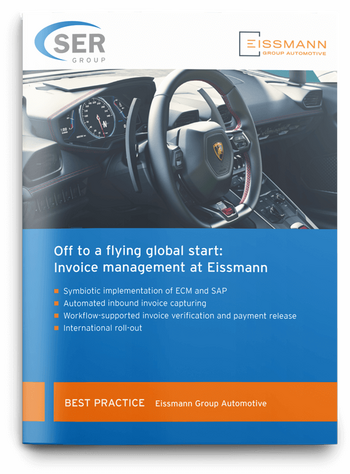
Eissmann Group Automotive: International invoice management
Read all about how Eissmann Group Automotive transparently, swiftly and securely processes invoices worldwide
Read nowWhat to Look for in Enterprise-Grade AP Automation Software
Not every AP automation platform is built to handle enterprise complexity, even if the marketing says otherwise. A few capabilities separate platforms that scale from ones that will hit a ceiling:
- Deep ERP integration: native, certified integration with SAP and other enterprise ERP systems, not a generic connector that requires custom middleware
- Multi-entity support: the ability to manage separate legal entities, charts of accounts, and tax rules within one unified platform
- Configurable approval hierarchies: rules-based workflows that adapt to different business units, thresholds, and escalation paths
- High touchless processing rates: AI-driven extraction and matching accurate enough to keep exception volume manageable at scale
- Compliance and audit readiness: full audit trails, GDPR and ISO-aligned governance, and document retention policies that hold up to regulatory scrutiny
- A unified content layer: invoice processing that connects to the same enterprise content management system as contracts, HR documents, and other enterprise content, rather than living in an isolated AP silo
Common Mistakes to Avoid When Scaling AP Automation
Scaling AP automation across an enterprise is where most projects run into trouble. The technology is doing its job, but the rollout assumptions don't hold at size. These are the three mistakes finance and IT teams encounter most often, and how to get ahead of them.
Rolling out entity by entity without a shared data model
Automating each business unit in isolation, without a shared invoice data model and approval logic, compounds the problem rather than solving it. You end up with multiple automated silos instead of one consistent process. Standardize the data model and workflow rules before rolling out automation across entities, not after.
Underestimating exception volume
Even high extraction accuracy generates significant exception queues at enterprise scale. If your rollout plan does not account for who owns exceptions, how they are categorized, and how fast they need to be resolved, the exception queue becomes the new bottleneck. Key things to define upfront:
- Exception ownership per entity or cost center
- Escalation thresholds and timelines
- Reporting on exception root causes, so you reduce them over time
Treating AP automation as a standalone project
Invoices connect to contracts, purchase orders, and vendor master data. Automating AP in isolation from your broader content infrastructure creates another silo to maintain. The organizations that get the most from enterprise AP automation connect it to a unified content layer from the start, so every downstream process benefits from the same structured data.
How Doxis Approaches Enterprise AP Automation
When your AP team is buried in exceptions, chasing approvals across business units, or stitching together data from multiple ERP systems by hand, the platform underneath them is the problem. High-volume enterprise invoice processing needs infrastructure that was built for it, not adapted from a mid-market solution after the fact.
Doxis brings ECM, IDP, and BPM together in one unified Intelligent Content Automation platform, so invoice capture, AI-powered data extraction, and approval routing all run on the same system instead of a patchwork of point solutions.
For enterprise finance teams managing high invoice volume across multiple entities, that unification is what makes scaling possible without scaling headcount.
Doxis gives your organization:
- A single platform for capturing, extracting, and processing invoices across business units and ERP systems
- Native, certified SAP integration for invoice automation across both SAP ERP and S/4HANA, embedded directly in the SAP interface
- Configurable, rules-based approval workflows that match your existing organizational hierarchy
- AI-driven matching and exception handling that scales with invoice volume instead of falling behind it
- Enterprise-grade compliance, with GDPR and ISO-aligned governance and a complete audit trail
- Modular scalability, so you start with P2P automation and expand into broader content management without switching platforms
If your AP process is hitting its limits at enterprise scale, request a free demo below to see how Doxis handles high-volume invoice processing in practice.
Automate Work. Accelerate Business.
Bring together AI, ECM, and workflow automation in one powerful enterprise platform.
FAQs about Enterprise AP Automation
What is the difference between AP automation and enterprise AP automation?
Standard AP automation handles invoice processing for a single entity at moderate volume. Enterprise AP automation manages high invoice volume across multiple legal entities, currencies, and ERP systems while maintaining consistent compliance and approval controls.
How much invoice volume justifies enterprise AP automation?
There is no fixed threshold, but organizations processing thousands of invoices a month across multiple business units or ERP systems outgrow standard AP software and need enterprise-grade capabilities.
Does enterprise AP automation work with SAP?
Yes. Enterprise-grade platforms like Doxis offer native, certified integration with SAP ERP and S/4HANA, allowing invoice processing to run directly within the SAP interface rather than through a separate system.
Can enterprise AP automation handle multiple currencies and languages?
Yes. AI-powered extraction in enterprise AP automation software reads invoices in multiple languages and processes transactions in different currencies without requiring a separate template for every format.
What is touchless invoice processing?
Touchless invoice processing means an invoice moves from capture through posting without manual intervention. At enterprise scale, higher touchless rates are essential to keep exception queues manageable.
How does enterprise AP automation improve compliance?
It creates a complete, time-stamped audit trail of every step in the invoice lifecycle, including who approved what and when, which supports both internal controls and external regulatory audits.
What is the biggest risk when scaling AP automation across an enterprise?
Rolling out automation inconsistently across business units, without a shared data model or approval logic, creates more fragmentation than the manual process it replaces.
Is enterprise AP automation only for large companies?
It is built for organizations with complex structures, multiple entities, or high invoice volume. A single-entity business with low invoice volume does not need the same level of complexity.



How can we help you?
+49 (0) 30 498582-0Your message has reached us!
We appreciate your interest and will get back to you shortly.