

What is an EHR system? A complete guide to electronic health records
|
A patient's chart lives in a dozen places at once: the admitting hospital's system, the referring physician's notes, a lab's results portal, an insurer's claims file. Every handoff between those systems is a moment where protected health information can leak, get duplicated, or simply go missing, and compliance officers are the ones who answer for it.
According to IBM's Cost of a Data Breach Report (2025), healthcare breaches cost an average of $7.42 million each and take 279 days to identify and contain, longer than any other industry. An EHR system is supposed to fix that fragmentation. Used well, it becomes the biggest single compliance surface an organization has.
This guide breaks down what an EHR system actually is, the benefits and risks it brings, and the legal requirements that apply depending on where your organization operates.
Key takeaways
- An EHR system is a digital record of a patient's health information, built to be shared across the providers treating that patient
- Nearly every country has its own legal framework for electronic health records: HIPAA in the US, UK GDPR and the emerging Single Patient Record in Britain, the mandatory opt-out ePA in Germany, and the DMP inside Mon espace santé in France, among others
- Centralized records improve care coordination and cut duplicate testing, but they also concentrate risk: a single breach exposes far more data than a paper file ever could
- Compliance depends less on the EHR itself and more on how the documents feeding into and out of it are stored, retained, and audited
- Standards-based integration keeps an EHR system connected to the rest of your document environment long after any single vendor relationship ends
What is an EHR system?
An EHR system is software that stores and manages a patient's health information electronically, in a format designed to be shared across the providers treating that patient. It holds diagnoses, medications, lab results, imaging, and treatment history in one continuously updated record.
The term gets used loosely, so it helps to separate it from two related ones. An electronic medical record (EMR) is the digital chart kept by a single practice or hospital, built for internal use. An EHR is broader by design: it follows the patient across providers. Several countries also have their own statutory version of this concept with its own name and legal basis, such as Germany's ePA (elektronische Patientenakte) or Austria's ELGA, which function as a nationally regulated EHR.
Legal requirements for EHR systems by country
Electronic health records sit inside some of the strictest data protection frameworks that exist, and the specific rules vary sharply by country.
United States
There is no single federal mandate requiring every provider to run an EHR system, and the US healthcare system itself is a mix of public programs and private insurers, not one national scheme. What does apply universally is the Health Insurance Portability and Accountability Act (HIPAA), in force since 1996, which sets physical, network, and process-level security requirements for anyone handling protected health information (PHI). Any organization treating US patients and storing their data electronically falls under HIPAA's compliance rules, whether it runs a formal EHR system or a patchwork of tools.
United Kingdom
The NHS manages patient information as a single, taxpayer-funded system. Coverage today comes from regional Shared Care Records, which let providers in a given area exchange patient data, plus the Federated Data Platform, which supports operational functions like waiting-list and discharge management. In 2026, the UK government introduced the NHS Modernisation Bill to legislate a Single Patient Record: one authoritative digital record spanning a patient's whole NHS and social care history, with patient-facing access through the NHS App expected from 2028. Patient data itself is governed by UK GDPR and the Data Protection Act 2018, adopted after Brexit as the successor to EU GDPR.
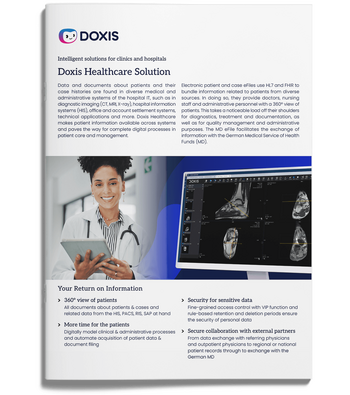
Intelligent solutions for clinics and hospitals
Doxis Healthcare makes patient information available across systems and paves the way for complete digital processes.
Read nowBenefits and challenges of electronic health records
Hey Doxi, what are the benefits and challenges of electronic health records?
Key benefits of an EHR system
- Centralization: all of a patient's health data lives in one continuously updated place
- Better clinical decisions: providers see a patient's full history across every visit, not a single snapshot
- Fewer duplicate procedures: shared access means tests and imaging already on file don't get repeated unnecessarily
- Smoother communication: patients and providers work from the same shared record
Compliance challenges and risks of EHR systems
The same centralization that makes an EHR useful is what makes it a compliance liability when it's mismanaged.
- Regulatory exposure: HIPAA in the US and GDPR-derived frameworks across Europe carry real financial consequences. HIPAA civil penalties can reach into the millions of dollars per violation category depending on culpability, and EU GDPR penalties can reach up to 4% of global annual revenue
- Provider resistance: hospitals and practices already run their own internal systems, and staff can experience a shared statutory record as one more administrative burden layered on top of clinical work
- Incomplete records: many statutory frameworks let patients withhold specific documents from certain providers, which can leave a treating clinician without the full picture
- Unauthorized access: a record built to be shared across many providers has more access points than one confined to a single practice, and each one is a potential point of failure
- Technical downtime: when an EHR system or its connected infrastructure goes offline, providers can lose access to active treatment information at the worst possible moment
- Data entry errors: a mistaken diagnosis code or mismatched patient ID propagates to every provider who later relies on that record
Where your EHR documents fit into a wider compliance strategy
An EHR system manages the clinical picture, but it was never designed to be the long-term, audit-proof archive for everything that feeds into it. Referral letters, consent forms, insurance correspondence, discharge summaries, and diagnostic images all need to be captured, classified, and retained under rules that can outlast the EHR vendor contract itself.
That's a document management problem as much as a clinical one. Documents need to be findable years after the encounter that created them, retained for the legally mandated period for that record type and jurisdiction, and protected by an access model that reflects who actually needs to see them. When these functions live inside the EHR itself, they tend to be an afterthought. Run them on a dedicated content platform instead, and the EHR stays focused on active treatment while the underlying documents stay compliant regardless of what happens to the clinical system around them.
This is also where interoperability standards do the real work. An EHR system that can only talk to itself recreates the exact fragmentation it was meant to solve, just one layer down.
Managing EHR-related documents and compliance with Doxis
Doxis works alongside your EHR system rather than replacing it, and it isn't a certified EHR itself. What it does is give healthcare organizations a compliant, centrally managed archive for everything that surrounds the EHR, connected through the same interoperability standards hospital IT teams already use: HL7 v2 for admission, transfer, and discharge messaging, and a FHIR R5 service for exchanging Patient, Encounter, and Document resources. This integration is standards-based, so it works with the EHR platform you already run without a vendor-specific plug-in to maintain.
That capability sits inside Doxis for healthcare, part of the broader Doxis Intelligent Content Automation platform that financial services and manufacturing customers also use for contract management and invoice processing. For healthcare specifically, documents captured from the EHR, DICOM imaging archives, and referral or insurance paperwork land in one governed repository, with role-based access (clinicians scoped to their facility or ward, DRG coders scoped across facilities), a documented VIP protection concept for sensitive patient records, and an audit trail on every access.
- Centralizes documents from your EHR, PACS, and administrative systems in one compliant archive
- Applies role-based access control, including dedicated protections for VIP patients
- Supports HIPAA-compliant document handling alongside ISO 27001, GDPR, and SOC 1/2/3 certifications
- Connects via HL7 and FHIR R5, so clinicians can reach archived documents without leaving their primary system
- Automates retention scheduling so records are kept exactly as long as regulations require
- Extends the same governance model across every department in your organization
Doxis is recognized as a Leader in the Gartner® Magic Quadrant™ for Document Management, and an independent Forrester Total Economic Impact™ study found a 336% ROI over three years for organizations running Doxis. If your EHR strategy needs a compliant home for everything around it, get in touch with Doxis or request a demo.
Automate Work. Accelerate Business.
Bring together AI, ECM, and workflow automation in one powerful enterprise platform.
FAQs on electronic health records
What is an EHR system in simple terms?
An EHR system is software that stores a patient's health information digitally so it can be accessed and shared by every provider involved in that patient's care.
What's the difference between an EHR and an EMR?
An EMR is a digital chart used inside a single practice or hospital. An EHR is built to follow the patient across multiple providers and organizations.
Is an EHR system legally required in the US?
There's no single federal mandate requiring every provider to use an EHR system, but any organization storing electronic patient data must comply with HIPAA's security and privacy requirements.
Who can access my EHR system records?
Access depends on the country and the specific platform, but it typically includes your treating providers and, in most statutory systems, yourself through a patient portal. Patients in many countries can also restrict which providers see specific documents.
Is Doxis an EHR system?
No. Doxis is a document management and archiving platform that connects to EHR systems via HL7 and FHIR to store, secure, and retain the documents and images surrounding a patient's care.
How do EHR systems stay compliant with HIPAA and GDPR?
Compliance comes from the surrounding infrastructure as much as the EHR itself: role-based access control, audit logging, encryption, and defined retention rules for every document type, applied consistently across every system that touches patient data.
Is an EHR system legally required in the US?
There's no single federal mandate requiring every provider to use an EHR system, but any organization storing electronic patient data must comply with HIPAA's security and privacy requirements regardless of whether it runs a formal EHR.
Does HIPAA apply to documents outside the EHR itself, like referral letters or insurance correspondence?
Yes. HIPAA's protections cover protected health information wherever it's stored or transmitted, not just inside the EHR platform, so surrounding documents need the same access controls, audit logging, and retention discipline.
What is the Single Patient Record, and how is it different from what the NHS has today?
The Single Patient Record, introduced through the 2026 NHS Modernisation Bill, is planned as one authoritative digital record spanning a patient's whole NHS and social care history. Today's NHS coverage instead comes from regional Shared Care Records and the Federated Data Platform, which don't yet function as a single unified record.
What law governs patient data in UK EHR systems?
UK GDPR and the Data Protection Act 2018 govern patient data protection. The UK adopted this framework after Brexit as the successor to EU GDPR.



How can we help you?
+49 (0) 30 498582-0Your message has reached us!
We appreciate your interest and will get back to you shortly.