
 English
Doxis Blog Innovation & Technology
5 insights enterprise leaders shouldn’t miss in the 2026 Gartner® Magic Quadrant™ for Document Management
The 2026 Gartner® Magic Quadrant™ for Document Management is finally here. It evaluates 16 vendors across a market that we believe is one of the most strategically important in enterprise technology. And if your organization is struggling to find documents, losing time to manual processes or wondering why your AI investments aren't paying off, this report was written for you.
If you’re an enterprise application leader, here are five insights you don’t want to miss.
1. Document management is now foundational to enterprise AI strategy
For a long time, document management was treated as plumbing. Necessary, but not exciting. Definitely not strategic. That's changed, fast.
According to the 2026 report, "The document management platform market is substantial, valued at $18.9 billion in 2025, and projected to expand to $26 billion by 2028, reflecting a compound annual growth rate (CAGR) of 7.5 %." That kind of growth does not happen in a back-office category. As we see it, this happens when something becomes critical infrastructure.
And that is exactly what document management has become, we think — the foundational capability for digital and AI-driven work, enabling AI agents and assistants to deliver a seamless flow of enterprise information between people and applications, using documents that are governed, accessible and structured.
But for most organizations, here’s what tends to happen in practice: They deploy AI assistants and agents, and then, as the 2026 Gartner® Magic Quadrant™ for Document Management report notes, "Clients that pursue this strategy quickly start to encounter challenges with broad adoption, governance, and ROI." And in many cases we’ve worked on, the problem isn't necessarily the AI. It's the content the software is trying to work with. All those contracts, invoices, case files and emails are mostly unclassified, disconnected and invisible to the systems trying to use them.
Before you can get real value from AI, you have to solve that problem. In our view, the first step is understanding just how much unstructured data your organization is actually sitting on.
2. Unstructured data is your biggest AI challenge
For the most part, organizations are sitting on information that is inaccessible, and there's more of it than most people realize. The 2026 Gartner® Magic Quadrant™ for Document Management estimates that "70% to 90% of enterprise data is unstructured, posing a significant challenge for organizations that need to unlock its potential using AI and also mitigate the risks of poor information governance." That's a lot of information sitting in formats that AI can't easily read, search or act on.
The good news is that the report points to two document management capabilities that change this picture:
- Knowledge enrichment classifies, extracts and summarizes information so it's accurate, trusted and ready for AI to work with. Think of it as making your content AI-readable.
- Knowledge discovery is what that unlocks: users getting real insights through conversational AI assistants and agents, rather than filing a request and waiting weeks for a report.
Together, these two capabilities are what turn previously siloed information into a genuine strategic asset. We recommend keeping them in mind when you're evaluating vendors.
3. Collaborative and operational document management aren't the same thing
This one catches a lot of organizations off guard. According to the report, document management platforms actually serve two quite different purposes, and most vendors are built around one or the other.
- Collaborative use cases support the digital workplace, external collaboration and knowledge management. This is about helping people work together on shared content.
- Operational use cases facilitate content-centric business processes, enterprise application integration and information governance. This is the engine room stuff: e.g. finance, legal, HR, sales and R&D.
Vendors have traditionally performed well at one but not both. As we see it, that matters a lot when you're evaluating platforms, because a solution that's great for collaboration may completely fall over when you need it to automate document-heavy processes, integrate with your ERP or compliantly manage records.
In our view, some important questions to ask before you evaluate any vendor are: Which use case are we primarily buying for? And what could be next on the roadmap? Be honest about where your gaps are and make sure the platform you choose is actually built for that job.
4. The best document management is the kind you don't notice
Most people think of document management as a place you go to find files. A system you log into. That's one way to do it, but we think there's a better approach.
Your documents should show up inside the tools your teams already use every day. Not in a separate system. Right there, where the work is happening.
The report describes application integration as a core capability of leading document management platforms — connecting content directly into systems like SAP, Salesforce, Workday and Microsoft Dynamics 365.
Think about what that looks like in practice:
- A finance team member opens SAP to process an invoice. The relevant documents are already there.
- A salesperson opens Salesforce to update a deal. The contract is right there in front of them.
- An HR manager opens Workday to review a new hire. All the paperwork is already attached.
No switching between systems. No searching. No wasted time.
This only works if your document management platform connects deeply to the applications your business runs on. So when you evaluate vendors, ask one simple question: does your platform work inside the tools we already use, or does it sit beside them?
5. A Leader positioning reflects ‘Completeness of Vision’ and ‘Ability to Execute’
As we see it, knowing what puts a vendor in the Leaders category helps you ask sharper questions when you get to the shortlist.
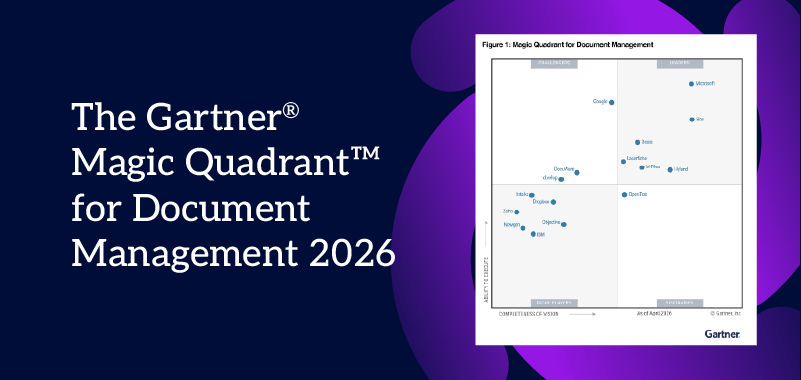
But what does that actually mean in practice? The two axes of the Magic Quadrant graphic break it down:
- From our view, ‘Completeness of Vision’ measures how well a vendor understands where the market is heading and whether their strategy reflects that. It looks at aspects like product roadmap, innovation, market understanding and vertical focus.
- As for ‘Ability to Execute’, we see that as the measurement of whether a vendor can actually deliver — across product quality, customer experience, sales execution and overall viability.
Together, we think the two axes give you a picture of not just what a vendor is promising, but whether they have the track record and operational strength to back it up.
Ready to read the full report for yourself? Click here to get complimentary access to the 2026 Gartner® Magic Quadrant™ for Document Management.
*Gartner, Magic Quadrant for Document Management, Tim Nelms, Jed Cawthorne, Rachel O'Farrell, Marko Sillanpaa, Stephen Emmott, 28 April 2026.
Gartner and Magic Quadrant are trademarks of Gartner, Inc., and/or its affiliates.
Gartner does not endorse any company, vendor, product or service depicted in its publications, and does not advise technology users to select only those vendors with the highest ratings or other designation. Gartner publications consist of the opinions of Gartner's business and technology insights organization and should not be construed as statements of fact. Gartner disclaims all warranties, expressed or implied, with respect to this publication, including any warranties of merchantability or fitness for a particular purpose.


How can we help you?
+49 (0) 30 498582-0Your message has reached us!
We appreciate your interest and will get back to you shortly.