

Legacy System Modernization: How to Replace Outdated Document Management Systems
|
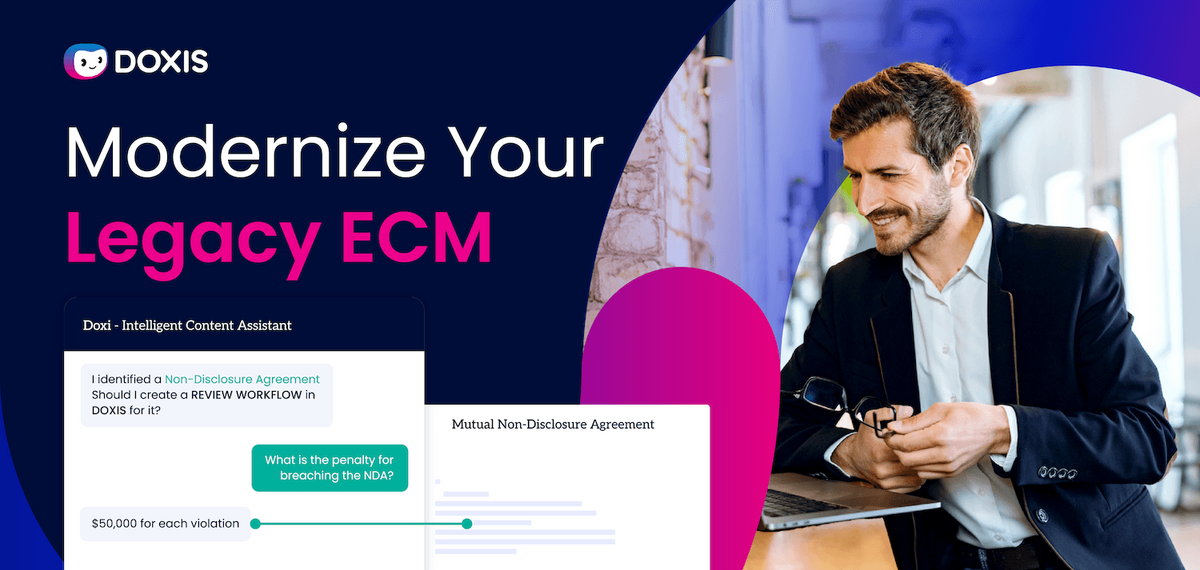
Many organizations still rely on legacy enterprise content management (ECM) systems that were implemented years or even decades ago. Some platforms continue to support critical business processes, but they were built for a different era of enterprise software. As organizations expand automation initiatives, adopt cloud technologies, and explore AI-driven workflows, these systems increasingly become barriers to innovation rather than enablers of it.
Many legacy system environments are heavily customized to accommodate country-specific requirements, departmental preferences, and unique workflows. Over time, this creates significant complexity: upgrades become difficult, maintenance costs rise, and organizations struggle to standardize processes across regions and business units.
At the same time, AI is raising new expectations for how business information should be managed. According to AIIM research, 78% of organizations are already operational with AI-driven document processing technologies. To support these initiatives, businesses need accessible, structured, and connected content that AI can understand and process effectively. Legacy ECM systems often lack the flexibility and architecture required to meet these demands.
This article explores why organizations are modernizing legacy ECM environments, the business benefits of doing so, and how modern content platforms support standardized, AI-ready business operations.
Key takeaways
- Legacy ECM systems often limit automation, integration, and scalability, creating operational bottlenecks that become more costly over time.
- AI initiatives depend on structured, connected, and accessible content. Many legacy repositories were designed for storage rather than intelligent processing, making AI readiness a major modernization driver.
- Highly customized ECM environments can create technical debt, increase upgrade complexity, and make it difficult to standardize processes across regions and business units.
- Organizations are increasingly shifting from custom-built workflows to standardized, configurable processes that are easier to govern, maintain, and update.
- Modernization no longer requires a full system replacement. Many companies reduce risk through phased transformation approaches that modernize high-value processes first.
What is a legacy system?
A legacy system is a business-critical application or infrastructure component that has been in operation for many years and continues to support core business processes. These systems are often deeply embedded into daily operations, making them difficult to replace despite relying on outdated technologies or architectures.
Many legacy systems were originally built as monolithic standalone applications with limited integration capabilities. Common examples include custom-built customer management systems, archive platforms, financial processing applications, or mainframe-based ERP environments. Over time, these systems evolved alongside the organization, becoming tightly connected to operational workflows and data structures.
While legacy systems may still perform their original function reliably, most were not designed for today’s enterprise requirements. Cloud deployment, real-time data access, API-based integrations, AI-driven automation, and scalable digital workflows were not part of their original architecture. As organizations expand automation and digital transformation initiatives, these limitations become increasingly visible across operations, compliance, and customer experience.
Why Legacy Systems Are Becoming a Business Risk
Legacy ECM systems often continue running without major technical failures, which makes modernization easy to postpone. But organizations now need faster access to information, standardized processes, AI-ready data, and seamless integration across applications. Many legacy platforms struggle to support these requirements efficiently.
Operational Inefficiencies
Many legacy environments depend on manual document handling, duplicate data entry, and disconnected workflows. Employees often switch between multiple applications to locate information, validate data, or complete approvals. This increases processing times and creates bottlenecks in document-intensive processes such as invoice approvals, contract reviews, and customer onboarding.
As organizations grow, these inefficiencies scale with them. Teams spend more time managing administrative tasks and less time on activities that create business value. Small delays across thousands of transactions can accumulate into significant productivity losses.
Growing Integration Complexity
Legacy ECM systems were typically designed before API-driven architectures became standard. Connecting them with modern ERP, CRM, HR, and collaboration platforms often requires custom integrations that are difficult to maintain and update.
Every new application added to the technology stack increases complexity. Organizations must invest additional resources to maintain integrations, synchronize data, and resolve compatibility issues. This slows modernization initiatives and increases long-term operational costs.
Compliance and Security Challenges
Regulatory requirements continue to evolve, requiring organizations to maintain strict control over business documents and records. Legacy systems frequently lack modern governance capabilities, making it harder to enforce retention policies, document traceability, and access controls consistently.
Security risks also increase over time. Unsupported software components, limited audit capabilities, and fragmented document repositories create vulnerabilities that can expose organizations to compliance violations, operational disruptions, or data breaches.
Limited Scalability
Many legacy platforms were designed for on-premises infrastructures and predictable business environments. Expanding these systems to support new users, business units, locations, or cloud services often requires significant effort and investment.
This lack of flexibility limits an organization's ability to respond to changing business requirements. Whether supporting remote work, entering new markets, or launching new services, legacy systems can become a constraint rather than an enabler of growth.
Poor Information Visibility
Business information is often distributed across multiple repositories, applications, and file shares within legacy environments. Employees may know that information exists but struggle to locate the most current version or access it quickly.
Limited visibility affects both daily operations and strategic decision-making. When documents, workflows, and business data cannot be easily connected, organizations lose context, reduce transparency, and make it harder for teams to collaborate effectively across departments.
Intelligent Content Automation for Enterprise Workflows
Discover how a modern ECM can help solve challenges and get insights on the goals and key focus areas of businesses digital transformation efforts.
Download the WhitepaperWhat Modernization Actually Means Today
Modernizing legacy ECM and archive systems is no longer only about replacing outdated software or migrating repositories to the cloud. Today, modernization focuses on improving how documents, workflows, and business information move across the organization.
Platforms such as Doxis, no longer pursue large-scale replacement projects that take years to complete. Instead, they modernize incrementally by introducing a centralized content layer that connects information across ERP, CRM, HR, finance, and operational systems. This approach reduces disruption while improving information access, process visibility, and governance.
A connected content layer allows documents and business data to remain linked regardless of where the information originates. Rather than managing disconnected repositories and department-specific workflows, organizations create a unified information environment that supports standardized processes and cross-functional collaboration.
This shift also enables organizations to modernize at their own pace. Individual processes, departments, or repositories can be transformed without requiring a complete overhaul of the existing technology landscape.
Legacy ECM Systems Were Not Built for AI
Artificial intelligence depends on access to structured, contextual, and connected information. Documents alone are not enough. AI systems need metadata, process context, business relationships, and consistent data structures to understand information and support automation effectively.
Many legacy ECM environments struggle to meet these requirements because they were designed primarily for storage and retrieval rather than intelligent automation. Common challenges include:
- Information silos: Documents are often distributed across multiple repositories, departments, and business applications, making it difficult for AI systems to access complete business context.
- Poor metadata quality: Years of inconsistent classifications, duplicate records, incomplete indexing, and varying naming conventions reduce search accuracy and limit the reliability of AI-driven analysis.
- Limited process visibility: Documents may exist independently of the workflows, transactions, and business events they support, preventing AI from understanding how information relates to operational processes.
- Automation constraints: AI-powered document processing, workflow automation, and decision support systems depend on connected information. When content remains fragmented, automation initiatives become difficult to scale.
As a result, AI readiness has become a major driver of ECM modernization. Organizations are not modernizing solely to improve document management. They are building an information foundation that enables AI, automation, and intelligent business processes to operate across the enterprise. According to AIIM research, 78% of organizations are already operational with AI-driven document processing technologies, increasing the need for structured, accessible, and connected content environments.
The Business Benefits of Legacy System Modernization
Hey Doxi, what are the key operational improvements of modernizing legacy systems?
Faster and more efficient workflows
Modern platforms automate repetitive document-driven tasks such as approvals, routing, validation, and information retrieval. This reduces manual work, shortens processing times, and improves operational consistency across departments.
Improved AI and automation readiness
Modern systems provide structured, searchable, and connected information that AI technologies can process effectively. This enables intelligent document processing, automated data extraction, workflow orchestration, and faster decision-making.
Better integration across enterprise systems
Modern content platforms support API-based integrations with ERP, CRM, HR, and collaboration systems. This creates a more connected IT architecture and reduces data silos across the organization.
Reduced operational and maintenance costs
Replacing fragmented legacy environments reduces dependency on expensive infrastructure, unsupported applications, and specialized maintenance expertise. Organizations also eliminate many manual workaround processes that consume time and resources.
Higher compliance and data transparency
Centralized document management improves auditability, traceability, and retention management. Modern systems also support regulatory requirements more effectively through role-based access controls, audit trails, and compliant archiving capabilities.
Greater scalability and operational flexibility
Modern systems adapt more easily to business growth, remote work, cloud deployment, and changing operational requirements. Organizations can scale workflows, users, and integrations without significantly increasing complexity.
Better employee and customer experiences
Faster access to information, automated processes, and reduced administrative work improve both internal productivity and customer-facing operations. Employees spend less time managing documents manually and more time on value-added tasks.
Why Companies are Replacing Highly Customized ECM Systems
Many legacy ECM platforms were implemented during a period when customization was considered a competitive advantage. Organizations invested heavily in tailoring workflows, interfaces, and business rules to match specific operational requirements. While this approach solved short-term process challenges, it often created long-term complexity that became increasingly difficult to manage.
The Customization Era
Many legacy ECM environments evolved through years of custom development to accommodate department-specific workflows, regional requirements, and local business processes. What began as targeted improvements often resulted in multiple workflow variations, custom integrations, and fragmented governance models that became increasingly difficult to maintain.
Doxis takes a different approach by combining configurable workflows, centralized content management, and enterprise-wide governance within a single platform. Instead of relying on extensive custom code, organizations can standardize processes across regions and departments while still supporting necessary local requirements through configuration. This reduces maintenance complexity, simplifies future upgrades, and creates a more scalable foundation for automation and AI-driven business processes.
The Hidden Cost of Customization
Highly customized environments introduce significant technical debt. Every upgrade, integration, or process change requires additional testing, development effort, and validation to ensure custom components continue functioning as expected.
Maintenance complexity also increases over time. Organizations must support multiple workflow variations, custom code bases, and region-specific configurations that may have accumulated over many years. This slows modernization efforts and increases dependence on specialized expertise.
Customization can also create governance challenges. When business processes differ across departments and locations, it becomes more difficult to maintain consistent compliance policies, reporting standards, and operational controls. As organizations expand, these inconsistencies can reduce transparency and limit process efficiency.
The Shift Toward Standardization
Many organizations are now taking a different approach and rather than customizing every process, they are standardizing workflows wherever possible and using configuration instead of custom development to address business requirements. Instead of maintaining multiple process variations and custom code bases, with Doxis, organizations can implement consistent workflows across departments and regions while supporting necessary local requirements.
This approach simplifies upgrades, reduces integration complexity, and creates a stronger foundation for automation and AI. The result is a more agile content management environment that can adapt to changing business needs without accumulating additional technical debt.
Common Legacy System Modernization Strategies
There is no single path to legacy system modernization. The right approach depends on factors such as system complexity, regulatory requirements, available resources, and the organization's appetite for change. Most modernization initiatives fall into two categories: full replacement or phased transformation.
A full replacement strategy involves migrating documents, workflows, and users to a new platform in a single program. While this can accelerate the retirement of legacy systems, it often requires significant planning, process redesign, and change management to minimize operational disruption.
Many organizations instead choose a phased transformation approach. Rather than replacing everything at once, they modernize individual processes, legacy repositories, or business functions in stages. Solutions such as Doxis Fast Starters support this model by enabling organizations to modernize targeted areas, such as invoice processing, contract management, or HR document workflows, before expanding to additional departments and use cases.
Phased modernization reduces risk, delivers measurable business value earlier, and allows organizations to build a connected, standardized content environment without disrupting critical day-to-day operations.
Turning Old into New: How Doxis Supports Legacy ECM Modernization
Replacing a legacy ECM system is rarely just a document migration project. The real challenge is modernizing how information moves across business processes without disrupting daily operations. Organizations need a way to connect documents, workflows, and business data while reducing the complexity created by years of customizations, disconnected repositories, and aging infrastructure.
Doxis supports legacy ECM modernization through a phased approach that allows organizations to modernize high-value processes first while maintaining business continuity.
- Centralized content layer: Doxis connects documents, metadata, and business records across ERP, CRM, SAP, HR, and archive systems, creating a unified information environment without requiring immediate replacement of every legacy repository.
- AI-powered document understanding: Doxis AI.dp automatically classifies documents, extracts business data, validates information, and makes content available for downstream workflows, reducing reliance on manual indexing and document handling.
- Workflow modernization: Legacy document-driven processes that can be automated through configurable workflows that replace email-based and paper-based routing.
- Integrated enterprise architecture: Certified SAP integrations and API-based connectivity.
- Compliant archiving and governance: Documents are archived in a revisions-safe repository that support regulatory and compliance requirements.
- Flexible deployment options: Organizations can modernize at their own pace through cloud, on-premises, or hybrid deployments, reducing migration risk while supporting existing infrastructure investments.
- Scalable foundation for AI and automation: By connecting content, metadata, and business context, Doxis creates the structured information foundation required for intelligent document processing, workflow automation, and future AI initiatives.
The business impact can be significant. In Forrester’s TEI study, SEW-Eurodrive achieved a 336% ROI after implementing Doxis, driven by productivity improvements, process automation, and reduced reliance on legacy systems.
Ready to modernize your legacy ECM environment? Request a Doxis demo and see how document management, workflow automation, and AI-powered content processing can help accelerate your transformation.
Automate Work. Accelerate Business.
Bring together AI, ECM, and workflow automation in one powerful enterprise platform.
FAQs on legacy system modernization
What is a legacy ECM system?
A legacy ECM (Enterprise Content Management) system is an older document and content management platform that still supports business-critical processes but was built before modern technologies such as cloud computing, API integrations, AI-driven automation, and intelligent workflows became standard. While these systems often remain functional, they can limit scalability, automation, and digital transformation initiatives.
Why are organizations modernizing legacy ECM systems?
Organizations modernize legacy ECM systems to improve operational efficiency, reduce maintenance costs, support AI initiatives, strengthen compliance, and enable better integration with modern business applications such as ERP, CRM, and HR platforms. Modernization also helps eliminate information silos and creates a more flexible foundation for future growth.
How do legacy ECM systems impact AI readiness?
AI systems require structured, connected, and accessible information to generate reliable insights and automate processes. Legacy ECM environments often contain fragmented repositories, inconsistent metadata, and limited process visibility, making it difficult for AI technologies to understand business context and scale automation effectively.
What are the biggest risks of keeping a legacy ECM system?
Common risks include increasing maintenance costs, limited integration capabilities, compliance challenges, security vulnerabilities, poor scalability, and operational inefficiencies. Over time, these issues can slow business processes, reduce visibility into information, and hinder digital transformation efforts.
Do organizations need to replace their entire ECM system at once?
No. Many organizations choose a phased modernization approach that focuses on modernizing high-value processes first. This allows businesses to reduce risk, deliver measurable results more quickly, and gradually transition away from legacy systems without disrupting daily operations.
Why are companies moving away from highly customized ECM environments?
Highly customized ECM systems often create technical debt, increase upgrade complexity, and require specialized expertise to maintain. Organizations are increasingly adopting configurable and standardized workflows that are easier to manage, govern, and adapt as business requirements change.
What are the business benefits of modernizing a legacy ECM platform?
Modernization can deliver faster workflows, improved AI and automation readiness, better integration across enterprise systems, lower operational costs, stronger compliance controls, greater scalability, and improved employee and customer experiences through faster access to information.
How does Doxis support legacy ECM modernization?
Doxis helps organizations modernize legacy ECM environments by creating a centralized content layer that connects documents, metadata, and business records across systems. It combines AI-powered document processing, workflow automation, compliant archiving, and enterprise integrations to modernize processes incrementally while maintaining business continuity.



How can we help you?
+49 (0) 30 498582-0Your message has reached us!
We appreciate your interest and will get back to you shortly.