

Doxis Blog Customer Stories & Use Cases
AI-powered document processing: How SEW-EURODRIVE makes global processes scalable
How SEW-EURODRIVE Processes 750,000 Documents with Doxis AI.dp
Whether it's a rollercoaster at Europa-Park, a cable car up the Zugspitze, or highly automated bottling lines, whenever something moves with precision anywhere in the world, SEW-EURODRIVE is often behind it.
But it's not just machines and systems that need to run reliably — enormous volumes of data are also processed daily within the company itself. With more than 750,000 customer documents per year, locations in over 50 countries, and numerous language and format variations, stable, scalable document processes have become a business-critical requirement.
However, as the company expanded internationally, complexity grew. Different layouts, changing formats, and country-specific requirements made traditional, rule-based approaches increasingly cumbersome.
The key question was therefore: How can global document processes be designed to be flexible and future-proof, without having to constantly define new rules?

When traditional OCR reaches its limits
Traditional document processing is usually based on templates and fixed extraction rules. As long as the structure and format of the documents remain the same, this works reliably. But as soon as layouts or languages vary, the maintenance burden grows significantly.
Every deviation means new rules, manual rework, greater susceptibility to errors, and rising operating costs.
At the same time, data must be available more quickly and, ideally, integrated directly into relevant ERP systems such as SAP. Throughput times become a competitive factor.
SEW-EURODRIVE opted for a technological approach that isn't based on rigid rules, but on a fundamental principle: understanding content in context.
contextual understanding
Hey Doxi, what does 'contextual understanding' mean?
AI in document processing means far more than traditional OCR. Instead of merely recognizing text, modern systems interpret content within its context.
A number, for example, isn't viewed in isolation — it's assessed within its contextual environment. Is it a total amount? An item number? A delivery date? The context decides.
What does this look like in day-to-day business? A typical use case at SEW-EURODRIVE is the processing of incoming customer orders:
- Orders arrive via email as PDFs from different countries, in various languages and layouts.
- The AI automatically recognizes relevant content such as customer reference, item numbers, quantities, prices, and delivery dates.
- The information is validated and transferred to SAP in a structured format.
- Only in cases of ambiguity, or when the system is uncertain, does an employee review the transaction.
The system focuses on contextual relationships rather than fixed document positions, so processing remains stable even with layout changes or new language variants.
Another key aspect is transparency. The solution shows the textual basis from which information was extracted and how reliable the assignment is. This traceability builds trust, particularly in sensitive business processes.
From rule-based systems to adaptive logic
For SEW-EURODRIVE, this approach represented a fundamental shift. Instead of constantly defining new rules, the company now uses an AI-powered solution that analyzes content in context and automatically forwards structured data to connected systems.
The benefits are clearly evident in the processing of around 750,000 incoming customer documents worldwide each year. The AI automatically classifies and extracts relevant information and transfers it directly to the connected system. This reduces processing times, minimizes manual rework, and improves data quality. Maintenance effort also drops, since new document variants or layout changes no longer need to be reconfigured rule by rule.
There's another key advantage: the technology is constantly learning. Feedback from day-to-day operations improves quality step by step, without the need to maintain complex rule sets.
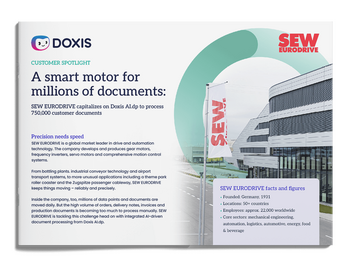
SEW-EURODRIVE: A smart motor for documents
SEW-EURODRIVE capitalizes on Doxis AI.dp to process 750,000 customer documents per year
Read nowScalability as a strategic factor
What began in the ordering process can be extended to other document types. New areas of application such as the automated processing of supplier declarations or payment notifications are already in the pipeline. New document types or locations can also be integrated without rebuilding the entire process from scratch.
This transforms document processing from an operational issue into a strategic component. It creates a robust data foundation for reporting, compliance, and downstream processes, while simultaneously reducing manual effort.
Technology that delivers: Implementation with measurable added value
At SEW-EURODRIVE, this approach was implemented using an AI-based solution for intelligent document processing, specifically Doxis AI.dp.
The focus is on not merely reading documents, but understanding their content and integrating them in a structured way into company-wide processes. For internationally active companies dealing with a wide variety of documents, this creates stable, scalable workflows and permanently reduces maintenance effort.
The specific benefits:
- High degree of automation even with varying layouts
- Reduction in maintenance and customization effort
- Rapid integration into existing system landscapes
- Transparent traceability of AI decisions
- Future-proof scalability for new document types and countries
The result is a stable, long-term document process and a genuine competitive edge for digital transformation.


How can we help you?
+49 (0) 30 498582-0Your message has reached us!
We appreciate your interest and will get back to you shortly.