

Doxis Blog Innovation & Technology
Why AI and digital modernization fail in financial services (and what actually fixes it)
Banks and insurers are spending more on AI and modernization than ever, and a lot of that money isn't paying off. A tool that dazzles in a demo often does almost nothing useful once it's working on real loan files and claims. In fact, Gartner expects at least 30% of generative AI projects to be abandoned after their trial run. While it's easy to blame the technology or the vendor, the real problem is usually underneath all of it: in the information these tools are built to run on.
Learn where that information foundation can be found, why it decides whether your AI and modernization pay off, and what it takes to solve this challenge.
The information problem blocking modernization in banking and insurance
It comes down to the documents. Nearly all the information a bank or insurer runs on is sitting inside millions of them, like the loan applications, claims, policies and emails people handle every day. And two main things make that information almost impossible to use.
First, the form the documents are in. Most arrive built for a person to read, not a computer, such as:
- Scanned images, like a signed application
- Faxed pages, like an incoming claim
- PDFs and email attachments, like a policy or statement
- Handwritten or typed forms that were never digital to begin with
- Most software just sees a picture, not the information and details inside these documents.
Most software just sees a picture, not the information and details inside these documents.
Second, the documents are scattered across separate systems that don't talk to each other, in places like:
- The core banking or policy admin system
- A loan origination or claims system
- A separate document archive
- Shared drives and email inboxes
By Gartner's estimate, 70 to 90% of a company's information is unstructured. As a result, no single place holds the full picture for your new software to draw from,. Even your own people lose time hunting for information.
That's the foundation everything sits on, and when it's broken, modernization simply isn’t possible.
How the information problem shows up across banks and insurers
You may already be noticing the symptoms of a broken information foundation in your team. Here are some examples:
- Underwriting: A mortgage gets approved on an incomplete file because the borrower’s income verification was sitting in a system nobody opened. The risk gets priced on half the picture, and it only surfaces if the loan goes unpaid.
- Claims: A claim stalls for days because the adjuster is waiting on the loss report to come through from another team, and the AI built to fast-track the claim can't read the form it arrived on anyway.
- Compliance: An examiner asks for every document tied to a loan approved in 2019, and answering means digging through the origination system, the archive and an email trail by hand, while the tool meant to flag risk early is only seeing a slice of the file.
- Customer service: A policyholder calls to ask why their premium went up, and gets put on hold while the agent checks three systems. Why? Because the policy, the billing history and the last call notes all live in different places.
- FinTech copilot: The AI is meant to summarize a loan file in seconds, but with the income docs in one system and the appraisal in another, it summarizes whatever it can reach and leaves out the rest, so underwriters can't trust its output.
What it takes to create an information foundation you can rely on
Most banks and insurers already have somewhere to put their documents, but they're using it as little more than storage. Picture a digital filing cabinet: it holds the files, but it can't read a word inside them, and it has no idea that the application in one drawer and the income documents in another belong to the same customer.
Fixing that means going beyond storage to a modern, AI-first document management system that can:
- Create a single source of truth: Wherever a document lives, in your core system, your origination or claims system, people reach it all from one place without hunting across five systems.
- Read, not just store: A scanned application stops being a flat image and becomes information the business can use, like the names, the numbers and the dates, whether it arrived as a scan, a fax or a PDF.
- Keep in context: Every document is tied to the customer, loan, policy or claim it belongs to, so the full file is there when an underwriter, an examiner or an AI model needs it.
- Manages the whole lifecycle: From the moment a document arrives to the years it has to be kept for a regulator, each is tracked, versioned and retained correctly, so nothing gets lost or wrongly deleted.
All of this has a name: Document Intelligence, the solution that helps AI and modernization deliver for banks and insuters. This article covers the basics, but there's far more to how it reads, connects and activates the information trapped in your documents.
See how Document Intelligence works in this quick two-page breakdown:
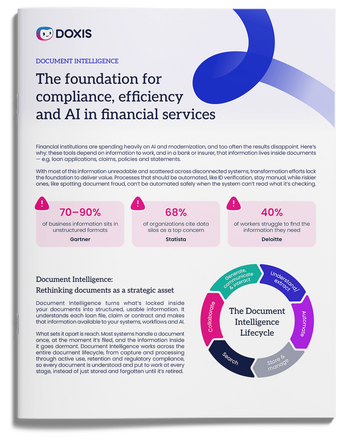
Document Intelligence - The foundation for compliance, efficiency and AI in financial services
Most bank and insurer data is trapped in documents. See how Document Intelligence turns it into usable data for faster, compliant, AI-ready operations.
Read it here


How can we help you?
+49 (0) 30 498582-0Your message has reached us!
We appreciate your interest and will get back to you shortly.