

Doxis Blog Innovation & Technology
Why AI transformation in purchase-to-pay keeps hitting the same wall
|

Almost every company is investing in AI now, and McKinsey says 92% plan to increase that investment over the next three years. But only 1% say they have reached real AI maturity, where AI is fully integrated into workflows and delivering substantial business outcomes. Purchase-to-pay is a good example of that gap in practice. It’s full of high-value use cases for automation, yet many teams still hit the same wall when they try to scale beyond isolated improvements: the work stays manual, things keep getting flagged for review and people still have to step in to keep things moving.
When progress stalls here, the problem isn’t the lack of AI tools. It’s the document-heavy, disconnected process underneath them.
What AI transformation in P2P is supposed to look like
When we talk about AI transformation in P2P, we’re usually talking about things like automatic invoice capture, PO matching, exception handling, approval routing and faster processing with less manual work.
That’s the promise. The reality is that a lot of teams are still nowhere near that point. In fact, a 2025 survey of AP and finance professionals found that 66% still manually key invoices into their ERP or finance system, and 63% spend more than ten hours a week on invoice processing. In the same survey, 73% said they were still not fully automated.
So even with all the talk about AI, a lot of the day-to-day work still looks the same: checking data, chasing missing information and stepping in when something doesn’t line up.
Why it breaks: the document foundation problem
In P2P, the process runs on information spread across documents: what was ordered, what was delivered, what was billed, what was approved and what terms were agreed.
For AI to help, it has to use that information to do real work. It has to check whether documents match, spot when something is missing, flag anything unusual like fraud or manipulation and decide whether a transaction can move forward or needs review.
The challenge is that this only works when the information is easy for the system to find, compare and trust. And in a lot of P2P processes, it isn’t.
The information is there, but it’s scattered across places like:
- invoices coming in as PDFs or scanned attachments
- purchase orders sitting in the ERP
- receipts or delivery confirmations logged in a separate system
- supplier terms buried in contracts or email threads
- approvals sitting in inboxes or workflow tools
So instead of having one clear, connected view, the AI has to deal with pieces of information that live in different places, follow different formats and don’t always line up.
Where this shows up in day-to-day P2P
That disconnect doesn’t hidden in the background for long. It shows up in the work itself. An invoice gets flagged because something doesn’t match. A PO is missing. A receipt cannot be found. The agreed terms are unclear. So instead of moving through the process, the transaction stalls.
And once that happens, the manual work you were trying to remove comes straight back to the team:
- someone checks the documents
- someone chases the missing information
- someone works out what is actually correct
- someone decides whether it can move forward
According to Gartner, it’s issues like these that cause teams to waste 47% of the day just trying to find information. The AI may be there, but without a solid document foundation underneath it, both the system and your people will keep running into the same bottlenecks.
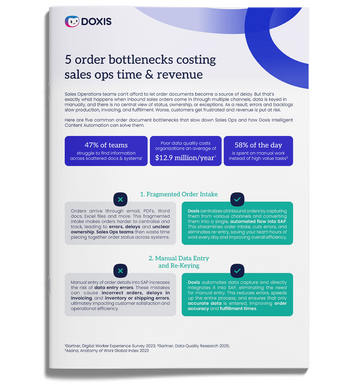
5 order bottlenecks costing sales ops time & revenue
Order delays rarely start on the factory floor. They start with fragmented documents and manual work that should be automated. Learn more inside this quick two-page read.
Read it hereWhat this starts to cost at scale
One stalled invoice is annoying. Hundreds or thousands start to cause real problems.
When work keeps dropping back to people, the impact spreads quickly:
- Payments get delayed because approvals are stuck
- Early payment discounts get missed
- Supplier relationships take a hit when things are late or disputed
- Cash flow becomes harder to predict because liabilities aren’t clear
- Teams spend more time firefighting instead of actually managing spend
It also makes scaling harder than it should be. As volumes grow, the manual work grows with them. More invoices means more exceptions, more chasing, more time spent figuring things out. So instead of AI reducing workload, teams end up needing more people just to keep up.
And when payments are delayed, it affects more than just the finance team. Suppliers get paid late, disputes increase and procurement and operations start to feel the impact. In fact, Atradius found that late payments affect 43% of B2B sales, which shows how quickly these delays spread across the business.
What a stronger document foundation looks like
If the bottleneck is bad document foundations, that’s where teams need to look next.
That usually means document management technology that can bring P2P documents into one connected flow instead of leaving them scattered across PDFs, inboxes, ERP records, contract folders, and separate approval tools.
In practice, that means being able to:
- capture documents in a format the process can actually use
- connect invoices, POs, receipts, approvals, and supplier records around the same transaction
- surface supporting documents inside the workflow instead of forcing people to go hunting for them
- keep a clear, traceable record from order through payment and archiving
Once that foundation is in place, AI has a much better shot at doing the work teams actually want it to do. It can match documents more reliably, spot gaps earlier, flag the transactions that really need attention and route the rest forward with much less manual checking.
Where P2P teams will make or break AI adoption
P2P teams are under real pressure to deliver AI that improves efficiency, reduces manual work and gives the business better visibility into spend. That pressure is justified. The opportunity is real.
But AI in P2P won’t deliver on that promise while the document foundation, where most of the transaction detail actually lives, is still scattered and disconnected from the process. The teams that fix that first will be the ones that make AI genuinely work. Not just in isolated steps, but across the full process from order to payment.
Next, why not check out our guide to eInvoicing compliance? It looks at another area where P2P teams are under pressure to adapt quickly as requirements change across countries.



How can we help you?
+49 (0) 30 498582-0Your message has reached us!
We appreciate your interest and will get back to you shortly.