

Doxis Blog Innovation & Technology
Why inventory and cash flow suffer when critical information is split across systems
|

How do you keep supply secure without tying up cash you don't have to spare?
The instinct is to hold more stock. And that makes sense up to a point. But more inventory means more capital tied up, higher carrying costs and pressure on cash flow that compounds over time. It trades one risk for another, and for most businesses, it doesn't fix the underlying problem: the information people need to make good purchasing decisions is split between ERP systems, supplier emails, invoices in approval queues and contract files stored elsewhere.
And when teams are working from an incomplete picture, they can't respond fast enough to prevent issues, so they buffer instead.
This article takes a deeper look at this issue, what it costs and what better-connected information across the purchase-to-pay process makes possible.
The problem runs deeper than external disruption
82% of companies report their supply chains are already being impacted by trade disruptions, affecting up to 40% of their operations. The pressure comes not just from the disruption itself, but from how difficult it can be to quickly understand the impact and work out the right response. As mentioned above, that usually means teams have to piece together the full picture from several separate sources. One system shows that an order exists, another thread explains what has changed, another workflow shows whether money has already been committed and another document defines the terms the business is working against.
As a result, teams are using less than 20% of the data available to them to support decision-making. This means no one has a clear, joined-up view of what’s happening across the purchase-to-pay process at any given moment. Decisions slow down, and people end up chasing updates, cross-checking documents and manually reconciling information that should already match. That also makes it harder to plan ahead, because purchasing decisions are being made without a clear picture of real demand.
What happens when teams can’t see the full picture
When teams cannot clearly see what has been ordered, confirmed, invoiced or put at risk, they end up responding to problems rather than preventing them.
That shows up in predictable ways:
- Over-ordering to avoid stockouts
- Missed opportunities to optimize spend or renegotiate contracts
- Late payments that strain supplier relationships
- Delays caused by mismatched or incomplete information
It also makes it harder for teams to stay aligned. Procurement, Finance and Operations are each working from partial information, so decisions get made in isolation rather than in coordination. What looks like a small issue in one area can quickly create knock-on effects elsewhere.
These are not edge cases. They are everyday friction points, and they compound over time, affecting both supply continuity and cash flow at once.
More inventory is a workaround, not a fix
Shifting to just-in-case inventory reduces short-term risk, but it doesn't address what's causing the problem — it relocates it.
Instead of exposure to shortages, businesses take on:
- Higher inventory costs
- More capital locked in stock
- Greater risk of waste or obsolescence
Carrying costs alone can account for 20–30% of total inventory value each year, creating a significant drain on working capital. Meanwhile, the same process inefficiencies are still there, now operating at larger scale. More inventory without better coordination just means more complexity.
So the business ends up paying twice: once for the extra stock, and again for the inefficiencies that made that stock feel necessary in the first place.
Manual process drag is also harming team productivity
There is another cost to all of this that is easy to overlook. Procurement and Finance teams are being asked to work in a more strategic, data-driven way, but too much of their time is still getting pulled into routine admin.
Instead of focusing on higher-value work, they end up spending time on things like:
- Chasing approvals
- Checking documents against each other
- Correcting mismatched data
- Figuring out which version of a record is actually the right one
That time has to come from somewhere. Usually, it comes from work the business needs more urgently, like supplier conversations, better planning and earlier decision-making. Over time, that creates a different kind of pressure. Teams are working hard, but too much of that effort is going into keeping the process afloat instead of helping the business move faster and make better decisions. But the workload is only part of the story. A lot of that extra work happens because information doesn’t carry cleanly from one step of the process to the next.
Why the process keeps breaking between steps
A purchase order may be created with the right context, but that context doesn’t always carry through to the invoice. Contract terms may be agreed upfront but not consistently reflected later when payments are processed. As a result, the context behind each step doesn’t always carry forward with it.
That creates a different kind of problem. Even when the steps are linked, the meaning behind them isn’t always consistent from one stage to the next. This is why businesses can still struggle even when core activity runs through ERP systems. The transaction is there, but the surrounding meaning does not always travel with it.
Until information holds together across the full purchase-to-pay cycle, each step remains dependent on its own interpretation rather than a shared understanding.
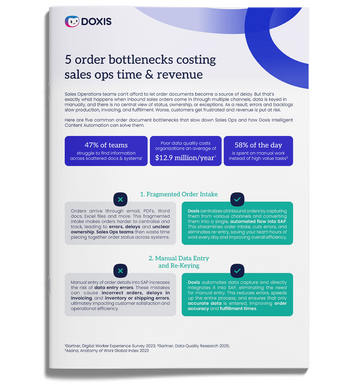
5 order bottlenecks costing sales ops time & revenue
Order delays rarely start on the factory floor. They start with fragmented documents and manual work that should be automated.
Read it hereA better way to connect information across the process
Businesses need more than additional stock or tighter cost controls. They need a better way to connect information across procurement, finance and operations and respond faster when issues arise, including in systems like SAP.
This is where many organizations are turning to solutions like intelligent content automation (ICA): software that takes the information inside documents like purchase orders, invoices and contracts and turns it into data that systems and workflows can use.
Instead of relying on manual work, it can capture documents, extract and validate data, route it to the right place and keep the process moving. That gives teams a clearer view of the purchase-to-pay process, helping them catch issues earlier, make faster decisions and manage cash flow with more confidence.
The goal is to make the process easier to manage
Supply chains are unlikely to return to how they were. Uncertainty, cost pressure and complexity are structural now, not temporary. The question for procurement and finance leaders has shifted from how to eliminate disruption to how to operate effectively despite it. That comes down to control:
- Control over information
- Control over processes
- Control over how decisions get made
When teams have a connected, reliable view of what is happening, protecting supply and protecting cash flow no longer have to pull in opposite directions. It becomes easier to make faster decisions, respond earlier and manage both with more control.
If this resonates, check out this other article exploring why the same visibility and information gaps also hold back AI transformation in purchase-to-pay, and why the real blocker is often the document foundation beneath the process, not the technology itself.

How can we help you?
+49 (0) 30 498582-0Your message has reached us!
We appreciate your interest and will get back to you shortly.