
 English
Doxis Blog Editorial
The Benefits of Cloud-Based Content Management
From static sites to dynamic, cloud-powered solutions
Whether you’re a pet charity, a maker of advanced electronics, or launching your latest AI solution, you need a strong digital presence. But a static, uninspiring website won’t attract attention—and as AI continues to transform how people search and discover online, it’s more important than ever to publish fresh, engaging, and well-structured content that speaks directly to your audience.
For decades, creating, managing, and updating this kind of content has fallen to content management systems, or CMS platforms. These systems began as custom, in-house tools—often standalone or tied to a broader e-commerce suite—but in recent years, most organisations have shifted toward cloud-based solutions for greater flexibility and efficiency.
Next-Gen ECM
Today, whether it’s storing documents, managing marketing assets, or enabling seamless collaboration across teams, businesses need systems that are not only scalable and secure but also built for the way we work now. Increasingly, enterprise content management delivered in the form of cloud-based content solutions is a form of cloud file management that knowledge managers see as the best way to get there.
By shifting content operations to the cloud, companies can unlock a range of benefits that enhance efficiency, enable smarter collaboration, and support sustainable growth, including:
Anytime, Anywhere Access
One of the biggest advantages of document management in the cloud is accessibility. Traditional content management systems often restrict access to on-premise networks, limiting flexibility and slowing productivity. In contrast, Cloud ECM enables users to securely access files, workflows, and data from any device, anywhere with an internet connection. This level of access is especially valuable in today’s hybrid and remote work environments, where teams are often distributed across different time zones and geographies.
Real-Time Collaboration
Cloud platforms enable seamless, real-time collaboration. Multiple users can view, edit, and comment on content at the same time—eliminating the inefficiencies of back-and-forth emails and version confusion. Many systems also include built-in tools like approval workflows, change tracking, and granular user permissions, making collaboration not only faster but also secure and compliant.
Scalability and Cost Efficiency
Hey Doxi, what about scalability and cost efficiency?
Cloud content management is built to scale. As your business grows and content demands increase, it’s easy to expand storage or add users—without the need for costly hardware or complex IT upgrades. Most cloud CMS platforms use subscription or usage-based pricing models, so you only pay for what you need, making it a highly cost-effective option for businesses of all sizes, especially small and mid-sized enterprises.
Enhanced Security and Backup
Cloud-based content solutions are designed with security at their core. Providers typically offer advanced encryption, multi-factor authentication, and strict compliance with international data protection standards such as GDPR and HIPAA. In many cases, cloud platforms deliver stronger protection than traditional on-premise systems. Automated backups further enhance resilience by ensuring content is regularly saved and quickly recoverable in the event of accidental deletion, cyberattacks, or system failures.
Seamless Updates and Integrations
With cloud content management solutions, software updates and security patches are automatically managed by the provider—removing the burden from internal IT teams and ensuring continuous access to the latest features and protections. Many cloud CMS platforms also integrate effortlessly with widely used tools like CRM systems, analytics platforms, and marketing automation software, creating a connected digital ecosystem that boosts efficiency and productivity.
Improved Compliance and Audit Trails
For industries with strict regulatory requirements, cloud-based content solutions offer built-in features like audit trails, access logs, and version histories. These tools simplify compliance reporting and help maintain internal governance standards, making it easier for businesses to demonstrate accountability and meet industry-specific mandates—while reducing risk and enhancing peace of mind.
Empowers Decentralised Working
Industry analysts highlight the strong potential of cloud ECM solutions for simplifying the storage, management, and sharing of content across dispersed teams and locations. They also emphasise the rising demand for centralised content repositories as organisations seek more agile, flexible ways to manage information and support collaboration at scale.
Cloud content management is revolutionising how businesses create, store, and share information. With benefits ranging from greater accessibility and collaboration to stronger security and cost savings, the advantages are undeniable. As organisations navigate digital transformation and the shift toward remote work, adopting document management in the cloud provides the flexibility and resilience essential for success in today’s content-driven landscape.
The promise of AI
The next stage in cloud content management’s evolution is already clear: Artificial Intelligence (AI). Solutions are already emerging that use GenAI content assistants to make it much easier for business users to do everything from creating new content to identifying content across multiple sources, while also providing shortcuts to translating, summarising, and automated tagging and categorisation of content.
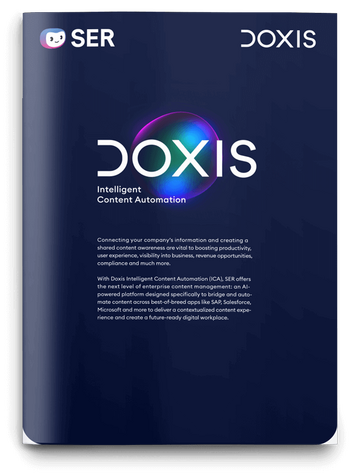
Doxis Intelligent Content Automation
With Doxis Intelligent Content Automation SER offers the next level of enterprise content management.
Read nowDoxis: Your partner for effective cloud content management
SER offers multiple powerful approaches to unlock the benefits of Cloud ECM and cloud-based content solutions.
This is possible because Doxis is a modular, scalable enterprise content management (ECM) platform that supports full cloud deployment alongside hybrid and on-premise configurations. It offers a flexible solution for companies transitioning to the cloud and serves as your next-generation document management system.
Next-level cloud content management
What sets Doxis apart is its AI-powered Doxis intelligent content automation, which takes enterprise content management to the next level. With intelligent content automation in the cloud, Doxis enables organisations to manage all types of content—structured and unstructured—while maintaining compliance, ensuring security, and enforcing robust information governance across departments and regions. The result: seamless, enterprise-ready cloud content management.
Doxis cloud services delivers high availability, global scalability, and certified data protection—including ISO 27001 and GDPR compliance—meeting the critical requirements of UK-based organisations operating in regulated industries.
Connecting enterprise systems
The platform integrates seamlessly with key enterprise systems—including SAP integration with Doxis, Microsoft integration with Doxis, and Salesforce integration with Doxis and other business applications—enabling end-to-end digital processes and eliminating content silos. Additionally, Doxis offers content automation supercharged with artificial intelligence features—including intelligent document classification, metadata extraction, and automatic filing—significantly boosting the efficiency and reliability of cloud-based content management.
Doxis also supports multi-cloud strategies and data sovereignty, allowing organisations to host their content in European data centres while maintaining full control over access and lifecycle policies.
Cloud content management FAQs


How can we help you?
+49 (0) 30 498582-0Your message has reached us!
We appreciate your interest and will get back to you shortly.